1962 Uniform Code of Operating Rules – Protection of Impassable or Slow Track

PROTECTION OF IMPASSABLE OR SLOW TRACK

40. (a) Before undertaking any work that may render the main track unsafe for movements at normal speed, or if rendered unsafe from any cause, trackmen, bridgemen or other employees must provide protection by sending out a flagman with flagman’s signalsin each direction at least 2000 yards from the defective or working point.

(b) After going out the required distance, flagman must take up a position where there will be a clear view of him from an approaching train of, if possible, 500 yards, first placing torpedoes not more than 100 nor less than 50 yards apart to cause two explosions at least 200 yards beyond such position.

(c) Flagmen must not return until recalled or relieved.

(d) If necessary to go beyond the required distance, flagman will leave the torpedoes at the required distance, but under such conditions must also place torpedoes at the point at which an approaching train is flagged.

(e) On the approach of a train flagman must display stop signals, using lighted fusees at night or in obscure weather.

(f) Trains stopped by a flagman will be governed by his instructions, and on reaching the defective or working point will there be governed by the foreman in charge.

(g) Flagmen must each be equipped for day time with:

A red flag on a staff
At least eight torpedoes and
Seven red fusees; and

For night time and when weather or other conditions obscure daytime signals,

A red light,
A white light,
A supply of matches,
At least eight torpedoes and
Seven red fusees.

41. On subdivisions or portions thereof specified in the timetable or special instructions, Rule 40 may be modified as follows:

(a) By day place a red flag and, in addition, by night a red light between the rails 200 yards in each direction from the defective or working point, and place torpedoes on each rail to cause one explosion 200 yards beyond the red signals, also:

(b) By day place a red over red flag and in addition, by night, a yellow light and a red light at least 2000 yards in each direction from the defective or working point to the right of the track as seen from an approaching train, and place torpedoes not more than 100 nor less than 50 yards apart to cause two explosions 200 yards beyond these signals.

(c) Trains approaching the signals prescribed by clause (b) must stop, replace the torpedoes and proceed to the red signal prescribed by clause (a) prepared to stop and there be governed by instructions or signal of the flagman, but must not proceed until the red signal has been removed in the clear view of the engineman.

NOTE: The red signal must not be removed except as authorized by the foreman in charge.

(d) When weather or other conditions obscure day signals night signals must be used in addition.

42.

43.

44.

45.

46.

47.

48.

49.
Recent Posts

Layout Update and 2026 Doubleheaders Tour

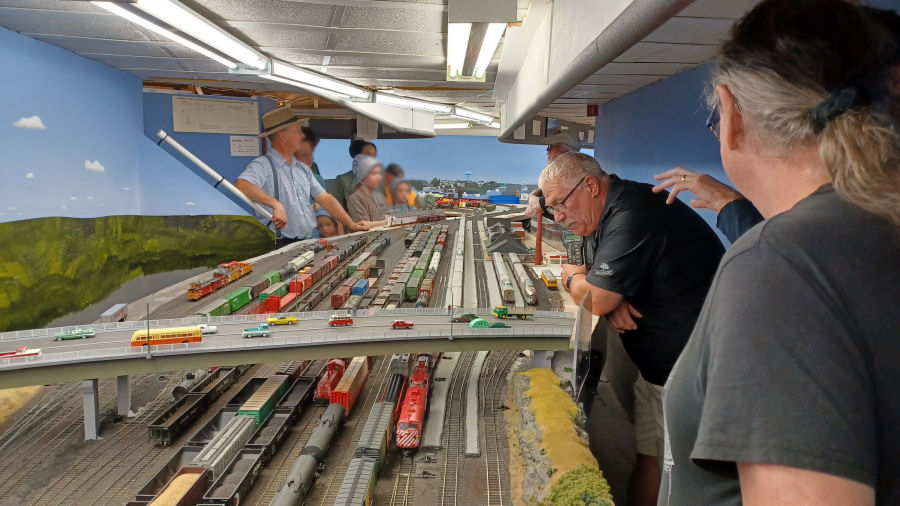
It’s that time of year again, our layout will be open to the public this coming Saturday, 28 March 2026, in participation with the annual Kitchener-Waterloo-Cambridge-Guelph and area layout tour, organized by the Doubleheaders Model Railway Club. This is a self-guided tour of a large number of club and private home layouts in the area.

If you are new to the Doubleheaders tour there are approximately 20 different layouts you can visit, varying from modular displays, large club setups to small N-scale pikes. You can see everything from tinplate trains to scratch-built prototype models. However the layouts are spread over a large area, and that makes it difficult to see them all in a day. So you should prepare for a full day of layout touring, and also maybe consider making this an annual, or at least semi-annual event to frequent over the years.

Please note; some layout are open until 9PM, however the CP Sudbury Division closes early at 5PM. If you are taking this year’s tour, please plan accordingly.

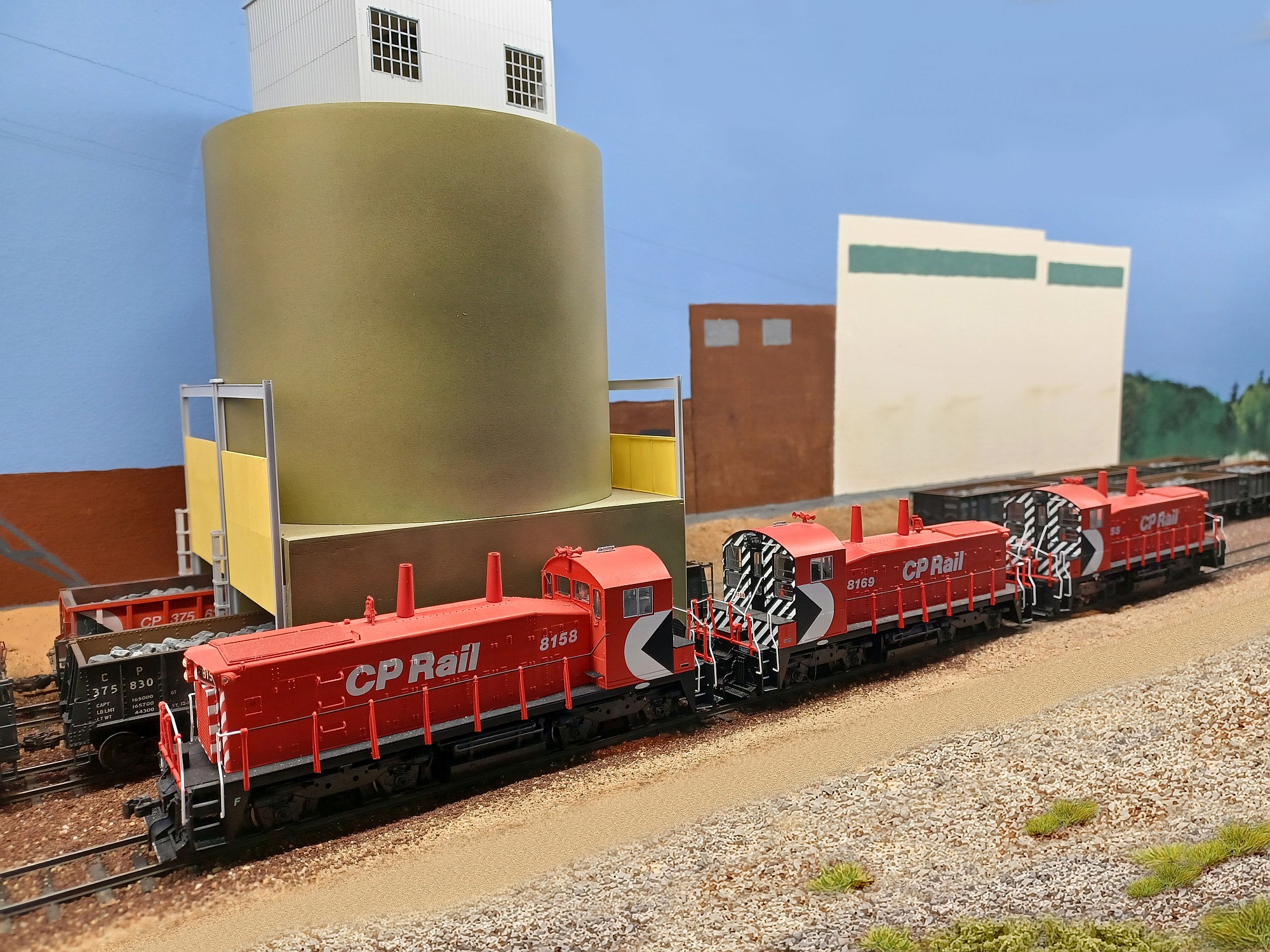
As usual we’ve been working on an number of layout projects over the winter in anticipation of the tour, at least as best as this year’s weather would permit. To start, we’ve completed the base scenery at our INCO – Crean Hill mine scene (photo above). If anything says ‘CP Rail in Sudbury’, it’s nickel ore trains; and not only do we have a large fleet of appropriate ore gons in service, but we now have a nicely sceniced mine for them to operate in. Well, as nice as an industrialized hole in the ground can look.

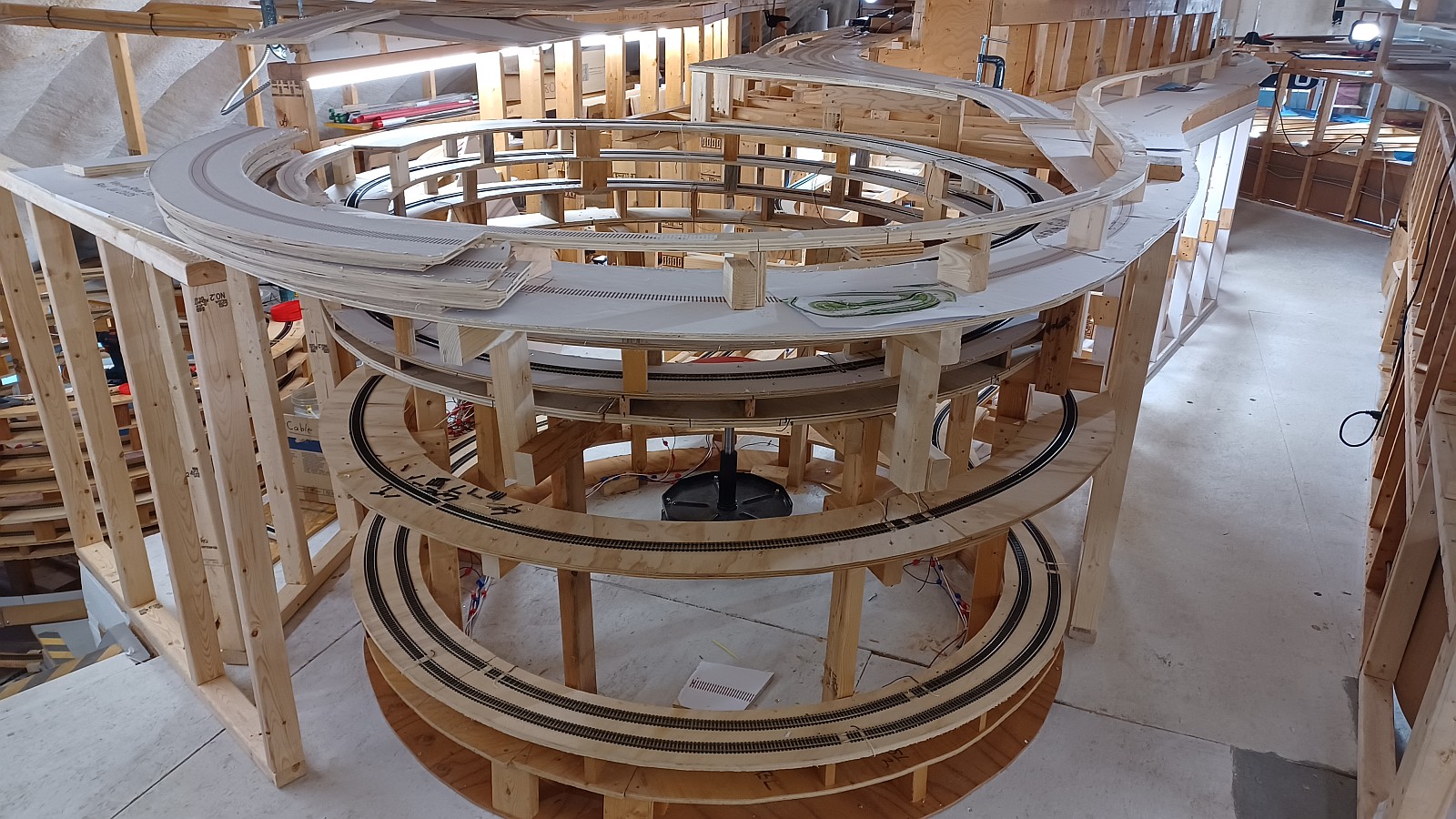
We also have a lot more carpentry happening upstairs as our layout expands to the second floor. The above photo shows what we’ve named the Verner helix, though like many of our helices it is actually connecting many different sections of the layout together. If you want the details, you’ll need to visit us and ask one of our friendly club members to find out. You will also see the new rails being laid at Levack, the benchwork at Sturgeon Falls along with the associated trackage at the Abitibi Paper mill located there, and much more.

Of course the feature attraction is seeing the fully operational portions of our CP Sudbury Division layout in action, with long sound-equipped freights running smoothly under DCC control. This is your chance to interact with us; to swap stories, exchange ideas, share techniques, and to celebrate the art of railway modelling, because that is always the best part of the world’s greatest hobby.

Hope to see you on the tour.

  1. Evolution of an Image – CP Freight Car Paint Schemes Leave a reply
  2. In Memorial: Jim ‘Skid’ Robinson Leave a reply
  3. 2025 Fall Open House Leave a reply
  4. 2025 Doubleheaders Layout Tour – Saturday March 29th, 2025 2 Replies
  5. Out With the Old, In With the New 3 Replies
  6. Falconbridge Nickel Mines Railway Leave a reply
  7. INCO Ore Operations on the Sudbury Division Leave a reply
  8. State of the Layout – March 2024 Leave a reply
  9. WRMRC Fall Open House – Saturday 14 October 2023 Leave a reply