1962 Uniform Code of Operating Rules – Centralized Traffic Control
RULES GOVERNING OPPOSING AND FOLLOWING MOVEMENTS OF TRAINS OR ENGINES BY SIGNAL INDICATION
261. On portions of the railway, and on designated tracks so specified in the time table, or by special instructions, trains or engines will be governed by block signals whose indications will supersede superiority of trains for both opposing and following movements on the same track.
262. Special instructions as may be necessary to govern this method of operation may be issued. Except as affected by such instruction and Rule 261 inclusive, all Operating, ABS, and Interlocking Rules remain in force.
CENTRALIZED TRAFFIC CONTROL RULES
Note: wherever the words “train dispatcher” appear herein, they apply to the employee performing the duties
263. Rule 261 applies in CTC. The movement of trains and engines will be supervised by the train dispatcher who will issue instructions as may be required.
The train dispatcher must be advised in advance of any known condition that will delay the train or prevent it from making usual speed.
264. When a train or engine is stopped by a signal indicating STOP and no conflicting movement is evident,
a) a member of the crew must immediately communicate with the train dispatcher, stating his name, occupation, location and train or engine number
b) If there is no conflicting movement, the train dispatcher may authorize the train or engine to pass the signal, but before doing so must provide protection against all opposing movements. The train or engine so authorized must proceed at restricted speed to the next signal and be governed by Rule 104A at spring switches, Rule 104B at dual control switches, and Rule 672 at automatic interlockings.
c) Instructions received from the train dispatcher must be in writing and repeated before being acted on, and train dispatcher must make the proper record immediately.
265. When a train or engine is stopped by a signal indicating STOP and all means of communication have failed, such signal may by passed under protection of flagman but only to enter the siding or clear the main track governed by the signal. Rule 104A must be complied with at spring switches, Rule 104B Paragraph 2 at dual control switches, and Rule 672 at automatic interlockings.
266. A train or engine may be given exclusive occupancy of a track or tracks within specified limits and specified times to perform switching or other work when authorized by the train dispatcher in the following manner: “(train or engine) may use (track or tracks) between … and … (or at …) …m until …m”
When requesting track and time limits, employee will give his name, occupation, location, train or engine number and specify time and work limits and track or tracks to be used. When such authority is granted, the instructions must be in writing and repeated to the train dispatcher before being acted on, and no movement may be made under this rule until the engineman has been advised and understands the track and time limits granted.
After the train or engine has entered the limits specified, the train dispatcher must block all levers controlling signals governing movements into such limits at Stop and must not remove lever blocks nor permit any other train or engine to enter the limits until track and time limits have expired unless the train or engine is reported clear or the track or tracks specified.
During the period track and time limits are authorized, the train or engine may use the track or tracks specified in either direction without flag protection.
The train or engine must be clear or the track or tracks specified, switches restored to normal position before expiration of the time specified, and the train dispatcher so advised. If not clear by the time specified, protection must be provided as prescribed by Rule 99. If additional time is required, authority must be secured from the train dispatcher before previously authorized time expires.
268. A train or engine may not enter nor foul a main track, nor re-enter a main track after having cleared it, except by signal indication or until permission has been received from train dispatcher.
269. In CTC, protection of rear of train on the main track between switches of a siding, and at such places as may be designated in special instructions, is not required.
270. Unless otherwise provided, train displaying signals will continue to display them through the territory.
272. When CTC operation is interrupted or suspended, trains and engines will be governed by instructions from the train dispatcher.
273. Special instructions as may be necessary to govern this method of operation will be issued. Except as affected by such instructions, Rule 261 and Rules 263-272 inclusive, all Operating, ABS, and Interlocking Rules remain in force.
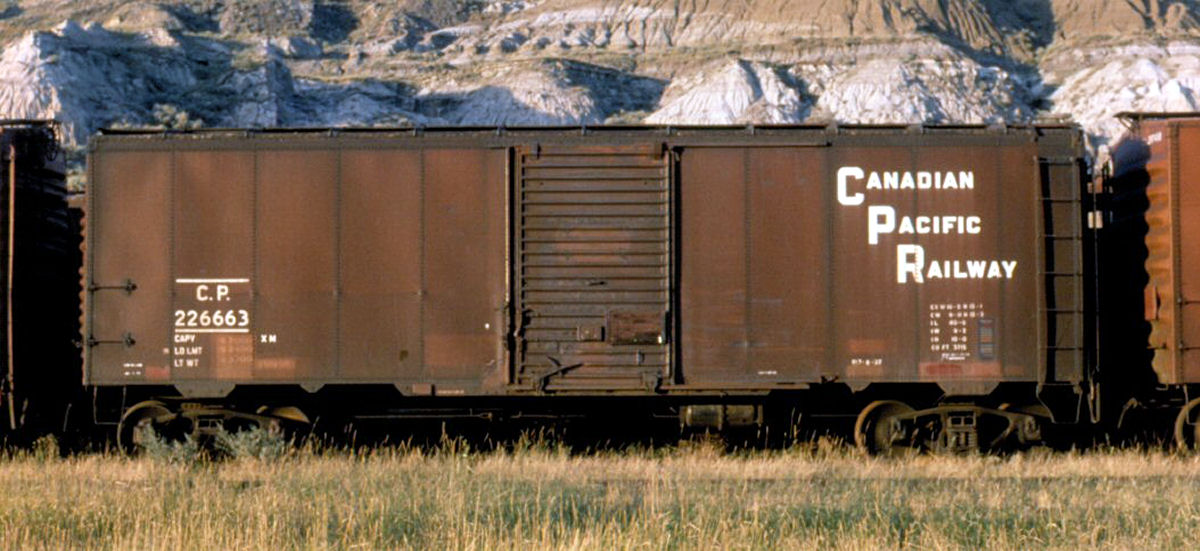
CP 226663 (CC&F blt-1937) at East Coulee AB – 28 Aug 1976. (Andy J Broscoe photo)
From the Great Depression until the 1970s, Canadian Pacific’s steel 40-foot boxcar fleet was the backbone of its freight-hauling business, serving key commodities such as grain, pulp & paper, high priority l.c.l., and general merchandise. Larger 50-foot boxcars and covered hoppers eventually phased out the 40-footers through the 1970s, but many lingered on in revenue service for the CPR until the early 1990s. In fact, the 40-foot fleet was so large and pervasive that a handful were still on the property into the mid-2010s utilized in non-revenue maintenance of way services.
From 1929 to 1962 the CPR would eventually amass a fleet of over 45,000 steel 40-foot boxcars. As one would expect, there were many changes in details and appearance spanning that production period, depending on the built-date, manufacturer, and application/service the order was intended for.
Furthermore, though Canadian boxcars were always based on U.S. designs, there were always unique ‘Canadianisms’ within their features. To begin there was an absence of poling-pockets, as the practice of poling freight cars (a hazardous switching method where a locomotive on one track used a wooden pole to push a freight car on an adjacent, parallel track) was banned in Canada in the early 1900s. Winter safety spawned the development of the segmented wooden roofwalk; constructed out of separate, distinct longitudinal segments versus the typical long-plank roofwalks found on U.S. railroads. Canadian railways also adopted the 8-rung ladder, versus the 7-rung commonly seen south of the border (some northern U.S. roads also utilized 8-rung ladders for winter safety). Additionally cold-climate features include stirrups attached under the end ladders, along with lateral roofwalks on steel straps attached to the sides.
This essay was intended as a general guide for modellers to help identify the different boxcar types, and cataloguing the various spotting features to assist in modelling these cars as accurately as possible. Based upon our club’s experiences, available HO-scale models and kitbashing advice (if required) are also listed.
CP ‘Minibox’ 8’-7” Interior Height Boxcars – The CPR’s first all-steel 40’ boxcars built 1929-30
Canadian Pacific purchased 7,500 of these boxcars (original road numbers CP 240000-247499) in a span of just over one year. Built to modernize its aging fleet of wooden-framed and wood-sheathed cars, the internal design was based upon the Pennsylvania Railroad’s ubiquitous X29 boxcar. Though externally the two cars were quite different, internally (from a shipper’s standpoint) they were the same boxcar.
Unlike standard X29 design boxcars that trapped water and rusted at the side sills, the CPR’s design utilized an innovative ‘tabbed’ side sill configuration attached via a steel angle to shed water effectively. This was the first known application of this type of sheathed attachment to the side sill, and evidence suggests this innovation was adopted by the American Railway Association when it developed their 1932 standard design.
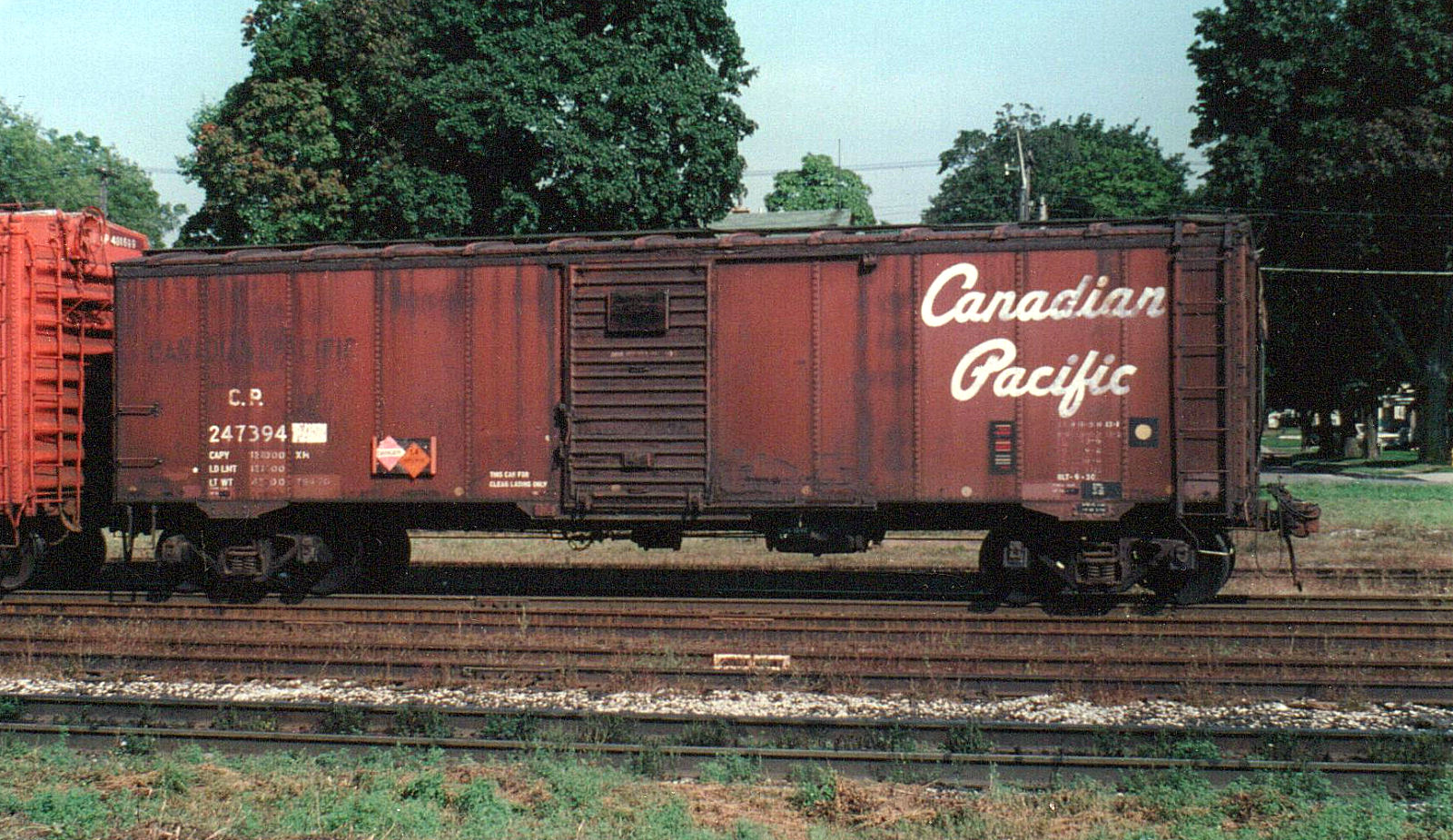
One can see how the ‘minibox’ earned its nickname when coupled next to a post-war built boxcar. CP 247394 (NSC blt-1930) at Galt (Cambridge) ON – 13 Sept 1990. (Ted Kocyla photo)
These were nicknamed the ‘minibox’ by modellers and railfans alike, due to the car’s low interior height (8′ 7″) when compared to post-WW2 built boxcars. However for the 1920s these were an average height boxcar, as many railroads were purposely building them shorter to clear low tunnels within New York City and other major northeast U.S. communities.
The major spotting features of the CP minibox include a Hutchins radial roof, 4/4-patterned reverse Dreadnaught ends, and a 5′ Youngstown door. They were built by three different manufacturers (National Steel Car, Canadian Car & Foundry, and Eastern Car Co.), though the CPR’s specifications for these boxcars meant there were almost no identifiable differences between builders.
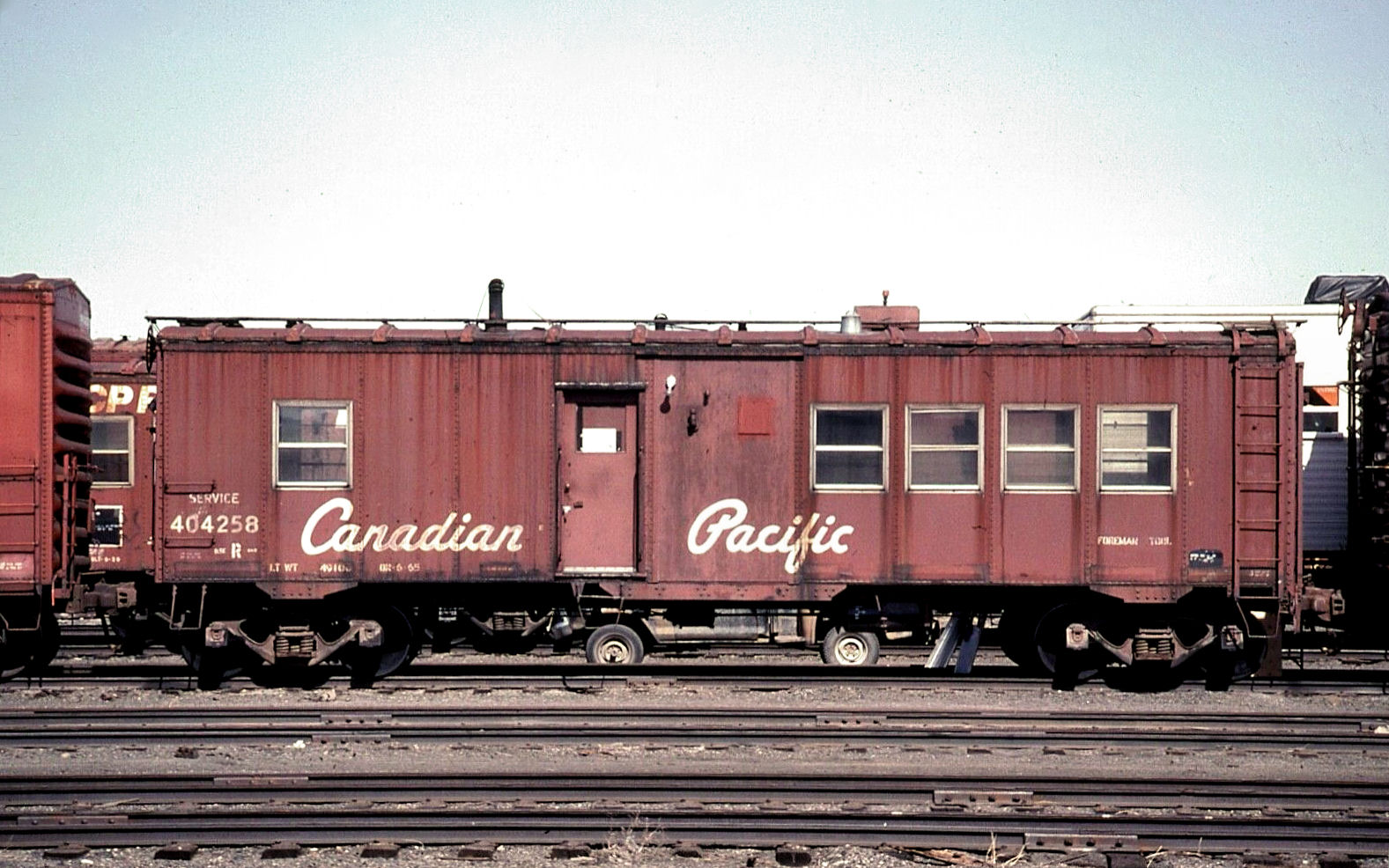
Due to the large number rostered and their sturdy construction, these were long-lived cars on the CPR. However, they were doomed by their low interior height which rendered them obsolete early and forced the fleet into grain and secondary services sooner than usual. By the 1960s a significant number of the extant minibox fleet were in maintenance-of-way service (CP termed it OCS – on company service) with many converted into camp cars. There were also a handful modified into icicle breaker cars utilized in the Western Region. These boxcars were so well built that there were still a few on the property utilized in maintenance service into the early 2000s.
CP 404258 is a former minibox converted into a maintenance service OCS camp car at Toronto ON (Lambton Yard) – 12 June 1993. (Ted Kocyla photo)
Despite their 40+ year age at the time, the 1972 official car register still listed over 1800 miniboxes in revenue service for the CPR. Though they were earning their last revenue miles in less than glamorous services, such as hauling cobalt nickel carbonate salts for INCO over the Sudbury Division. For those unaware, carbonate salt service was where boxcars went to die, as the corrosive nature of this commodity caused the floors to rust and rot out quickly.
CP Minibox Modelling Notes
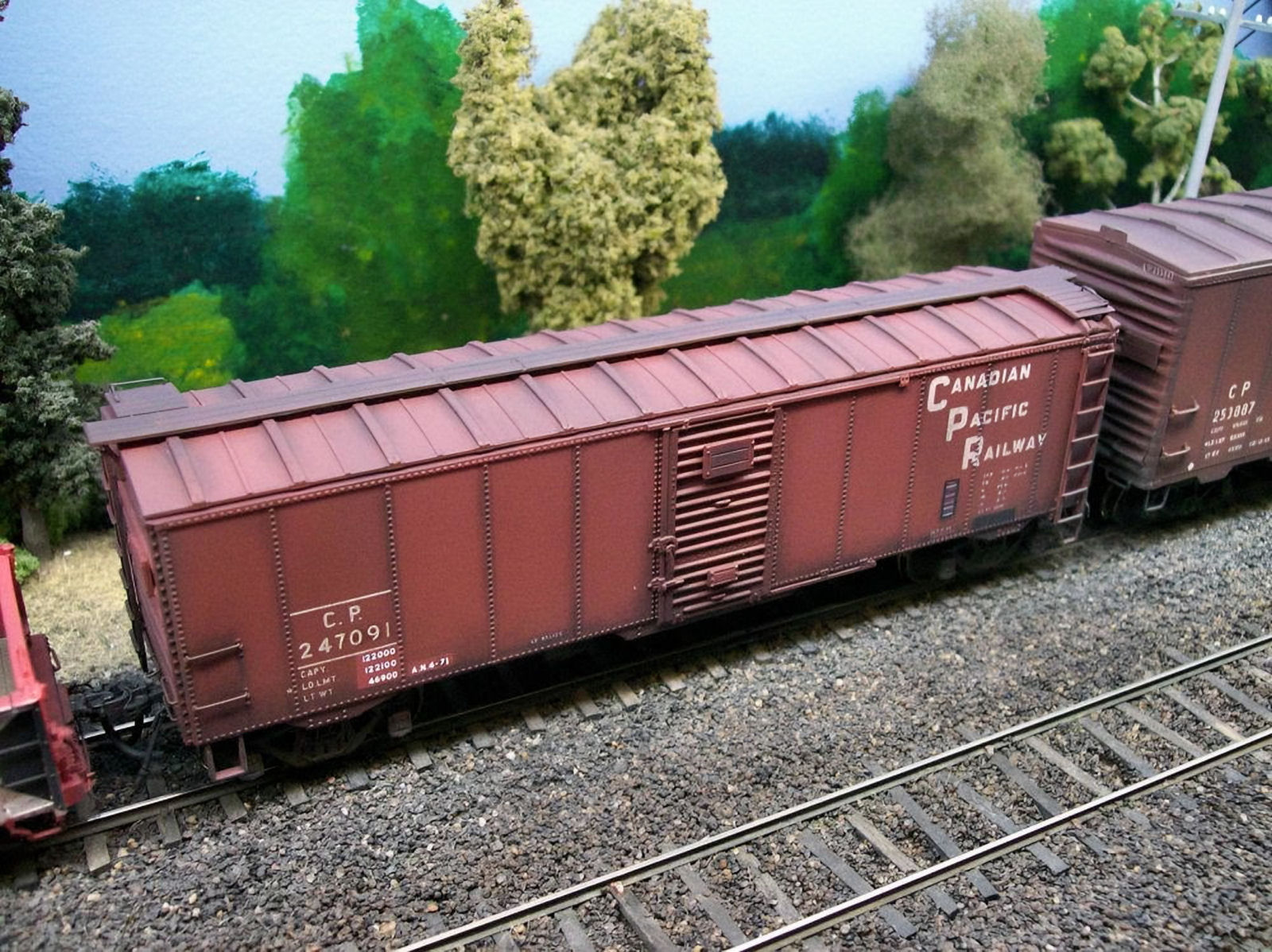
A True Line Trains ‘minibox’ model operating on the Sudbury Division layout. (WRMRC photo)
There are two different offerings of this boxcar for HO-scale modellers, the oldest being a craftsman resin kit produced by Funaro and Camerlengo. The WRMRC layout has a few of these F&C kits built, and they are of very good quality. There is also a great ready-to-run model initially produced by True Line Trains which can still be found at model train flea markets and estate sales. The good news here is Atlas has purchased TLT’s molds and continues to produce this boxcar, with a new run just released in 2026.
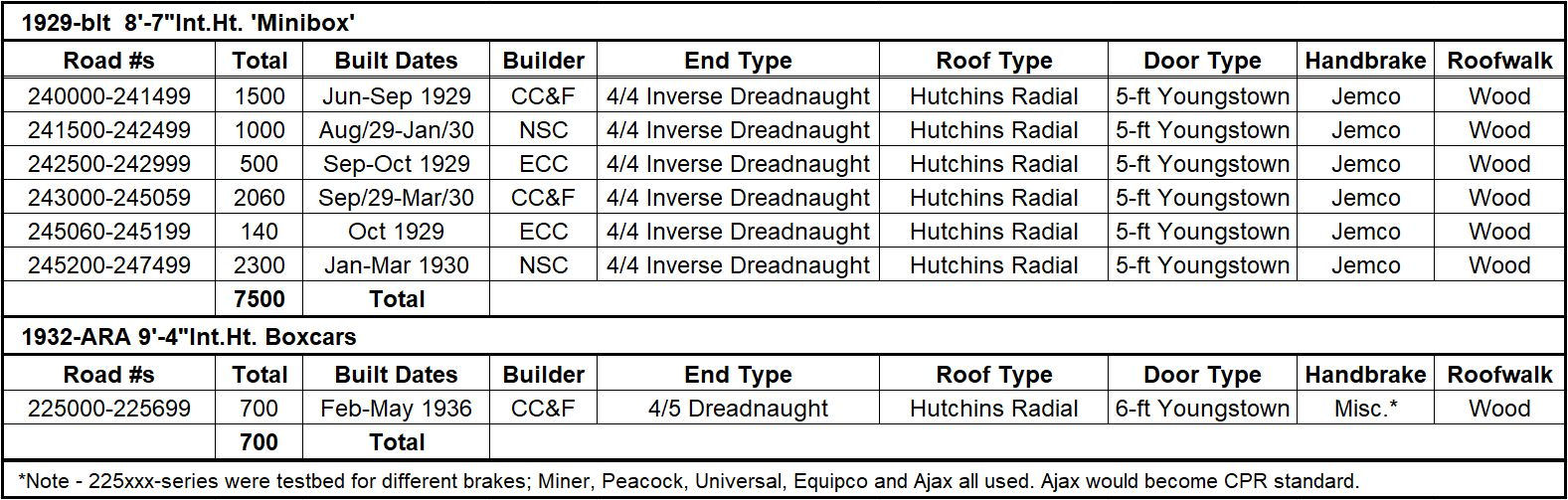
All time list of CPR 8′-7″ and 9′-4″ I.H. boxcars – (click to enlarge)
CP 1932-ARA 9’-4” Interior Height Boxcars – 700 built in 1936
You could call these the ‘Son of Minibox’, as with a 9’ 4” interior height these cars were still noticeably lower than post-WW2 built boxcars. The original number series for these cars were CP 225000 to 225699, all built by Canadian Car & Foundry in 1936.
CP 225546, a 1936-ARA designed boxcar at Cartier, ON – September 1, 1991. (Ted Kocyla photo)
By 1932 the American Railway Association (ARA – predecessor of today’s AAR) designated the standard boxcar height to rise to a 9-ft 4-inch interior height. This was the first instance of member railways settling on a standard boxcar arrangement, and resulted in over 14,500 of these boxcars being produced for 23 railroads. Though production numbers were small (the Great Depression didn’t help), it was nonetheless an important step in design and standardisation.
Due to the tight financial conditions of the depression, it took the CPR four years until they purchased any 1932-design boxcars, and then they only ordered 700. Though the ARA finally began to have influence on North American railroad standardisation of interior boxcar dimensions (quite helpful for shippers), the car manufacturers and individual railroads all built their own versions. The CPR’s 1932-ARA cars featured a Hutchins radial roof, with 4/5 pattern Dreadnaught ends, and a 6’ Youngstown door. With those features this is a unique car specific to the Canadian Pacific Railway; no other railroad had 1932-ARA cars with this arrangement.
Another peculiarity with these boxcars was the CPR’s experimentation with handbrakes. Canadian Pacific was changing over to the AB brake system in the mid-1930s (replacing older K-type brakes), and this order of 9′-4″ IH boxcars were a testbed of the various units available. Five different manufacturer’s handbrakes were applied sequentially starting from CP 225000 up; 100 Miner, 200 Equipco, 50 Ajax, 250 Universal, and 100 Peacock. Interestingly, despite having the smallest order, Ajax was the winner as they became the CPR’s standard handbrake for many years afterwards.
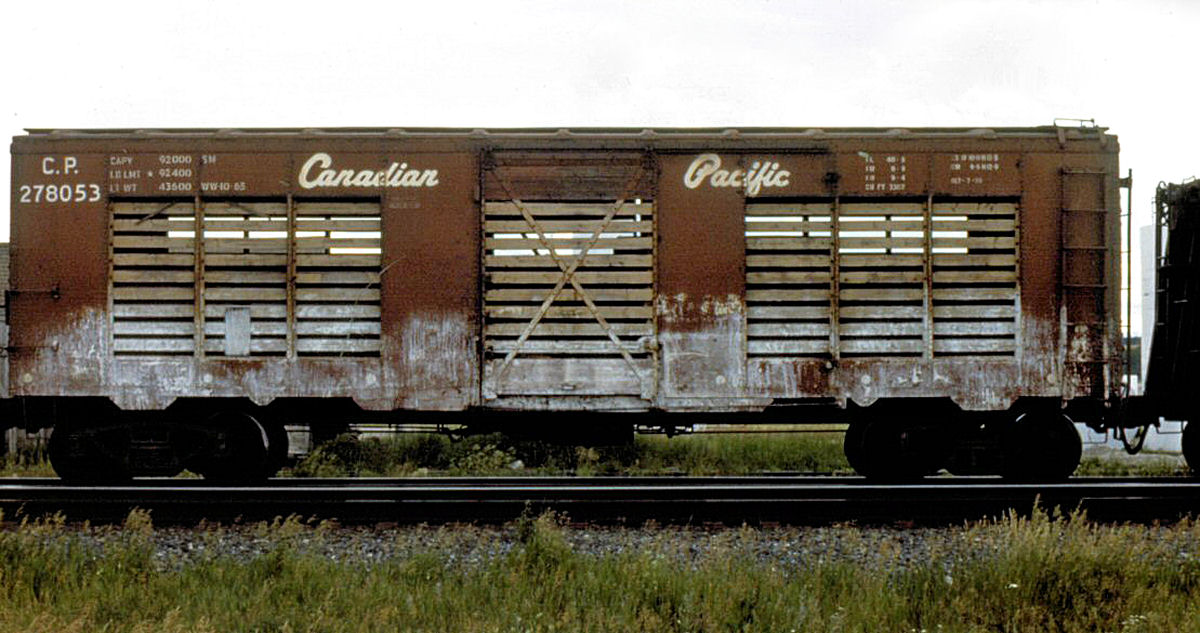
On an interesting side-note, 300 of the 1932-AAR cars were rebuilt between 1965-67 by the CPR’s Weston car shops into their unique ‘picture-window’ stock cars in the 278000-278299 number series. These cars survived right until the end of Canadian rail stock movements in the mid-1980s.
CP 278053, a stock car rebuilt from a 1932-AAR boxcar, at Cochrane AB – July 8, 1977. (Andy J. Broscoe photo)
With only 700 built, these cars may have been more difficult to spot versus their minibox cousins; however they were very durable cars that lasted for decades in the employment of the CPR. The 1975 official equipment register showed 264 still in revenue service. A few examples survived right until the end of the 40-foot boxcar era in the 1980’s, with some still operating in maintenance of way capacities well into the 1990s.
CP 1932-ARA Boxcar Modelling Notes
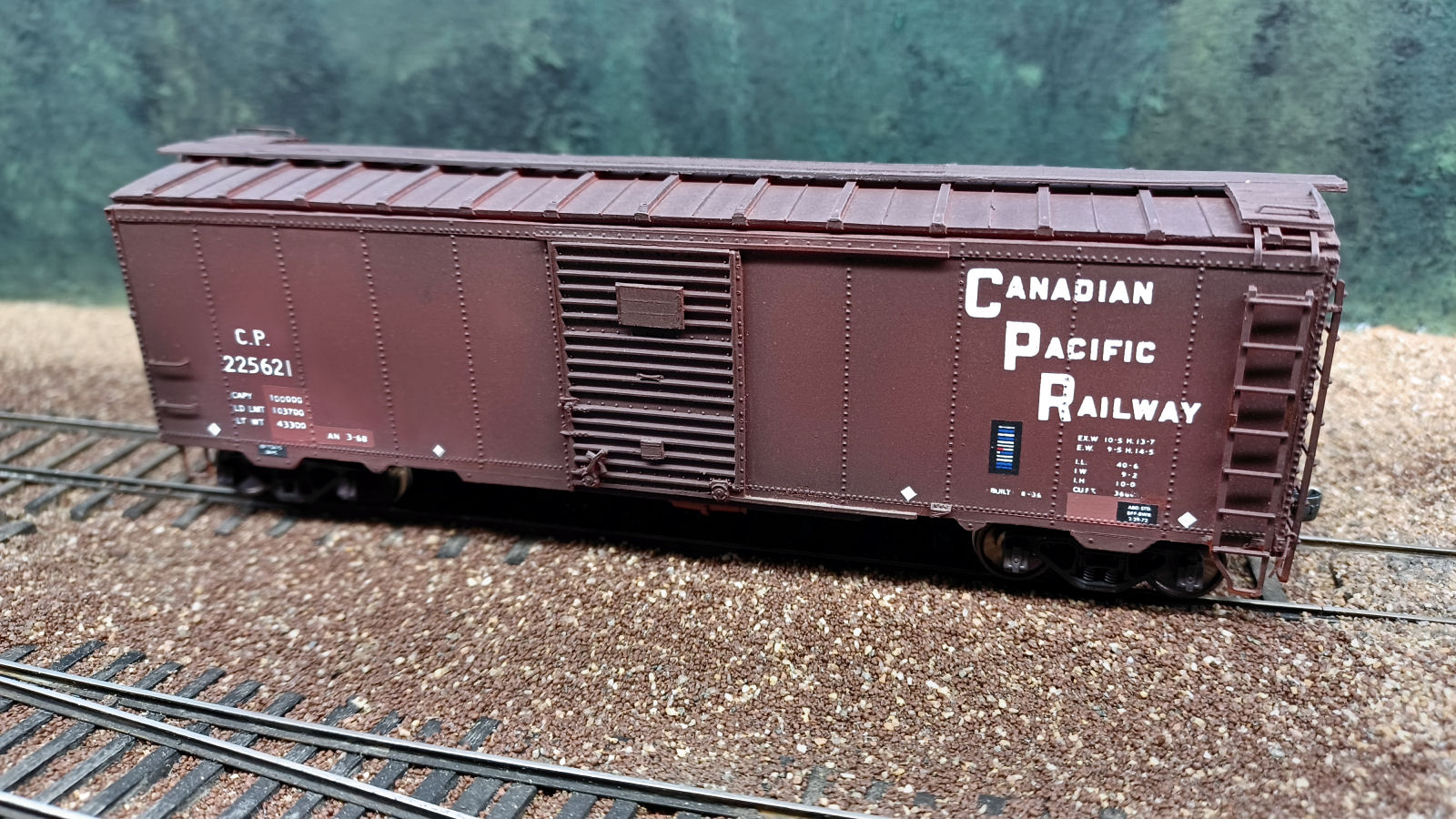
Funero & Camerlengo CP-1932ARA model operating on the Sudbury Division layout. (WRMRC photo)
With the CPR’s 1932-design boxcars being unique and built in limited numbers, that makes modelling them more of a challenge. There is an HO-scale resin craftsman kit available from Funaro and Camerlengo, which would be the best option. Atlas does produce a ready-to-run 1932-AAR car, however with CP’s unique features it would result in a serious kitbash project to render into an exact model.
CP 1937-AAR 10’-0” Interior Height Boxcars – 9650 built between 1937-46
Unlike the 1932-designed cars, Canadian Pacific went big for its successor, the 1937-designed boxcar. The layout itself was an update of the 1932-ARA car, with increased height and capacity, and newer components.
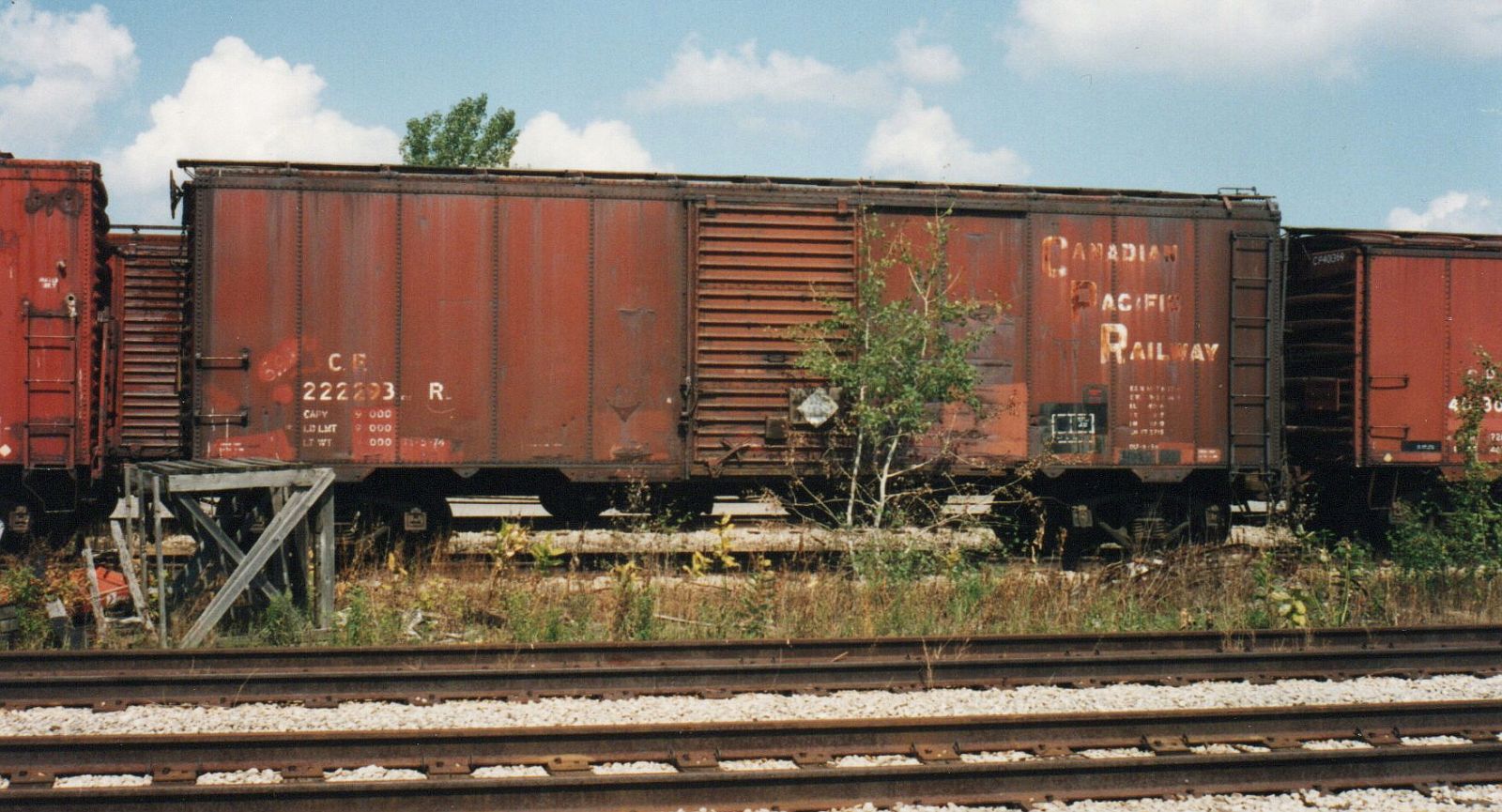
CP 222293 (NSC blt-1938) at Welland ON on 04 Sept 1995. (Ted Kocyla photo)
In 1936 the member railways of the Association of American Railroads (AAR) agreed to increase the standard interior height by 8 inches to an even 10-feet, but that was where uniformity ended with this design. Boxcar ends, roofs, and door-styles could all vary within the same railroad’s fleet, and Canadian Pacific was no exception. Additionally the design of the ends changed over the course of production, with early 1937-AAR boxcars featuring ‘Z’-shaped corner posts with a more squared-off exterior appearance, changing to ‘W’-shaped posts sometime around 1943 giving a more rounded appearance.
The 1937-AAR boxcar was a big seller on both sides of the border, with over 90,000 of these cars built for 64 different railroads. CN and CP together accounted for almost 28,000 of these, which is nearly 1/3rd of all 1937-design boxcars produced, and this made them a common sight across the continental rail network. These Canadian-built cars were unique in a number of ways, most notably for their lag in adopting the rectangular raised-panel Murphy roof and continuing to use the older flat-panel design as late as 1943. The Canadian roads also stuck with the 10′-0″ boxcar height well into 1946, this despite most major U.S. railways having adopting 10′-6″ height boxcars before the end of WW2, some as early as 1941.
These boxcars also introduced the integral sill step to the Canadian railway industry. The traditional stirrup step was attached separately as bolted-on or distinct welded brackets, whereas the integral step was built seamlessly within the ladder, side frame or side sill. This helped reduce the structural risk of stirrups twisting, bending, or tearing loose during switching operations, and gave these boxcars another Canadian uniqueness.
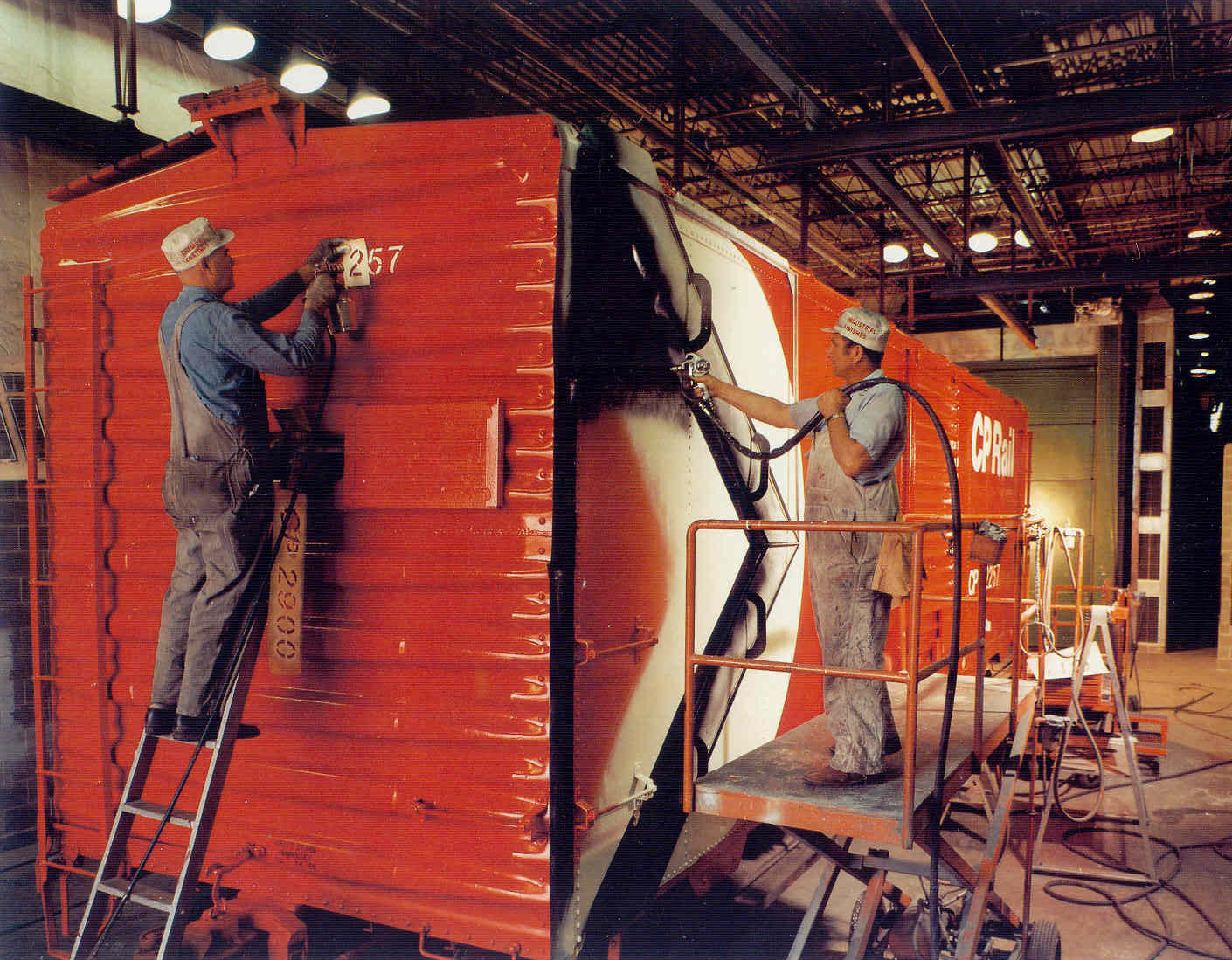
CPR publicity photo taken by company photographer Nicholas Morant showing workers at Weston Shops (Winnipeg) repainting CP 222257 into the CP Rail scheme in 1969. This is an early design 1937-AAR boxcar with Z-braced ends, built by NSC in 1938.
Between 1937 and 1946, the CPR purchased 9,650 of these 10’-0” boxcars from three different manufacturers. Canadian Car and Foundry built the lion’s share of the fleet with 7,650 cars, followed by National Steel Car for an additional 1,950 boxcars, and the Eastern Car Company building the final 50 cars to complete the fleet.
Over the nine year span of the CPR’s 10′-0″ boxcar production, the only constants between orders were the use of 6-ft Youngstown doors, and Ajax handbrakes. Not only did roof-types and end corner post changes occur in mid-production, but the final two orders saw the application of a new end-style. The final 1,000 boxcars built in 1946 from both CC&F and ECC saw the introduction of the 4/4-pattern Improved Dreadnaught end. This end-type would prove to become the CPR standard for the next ten years.
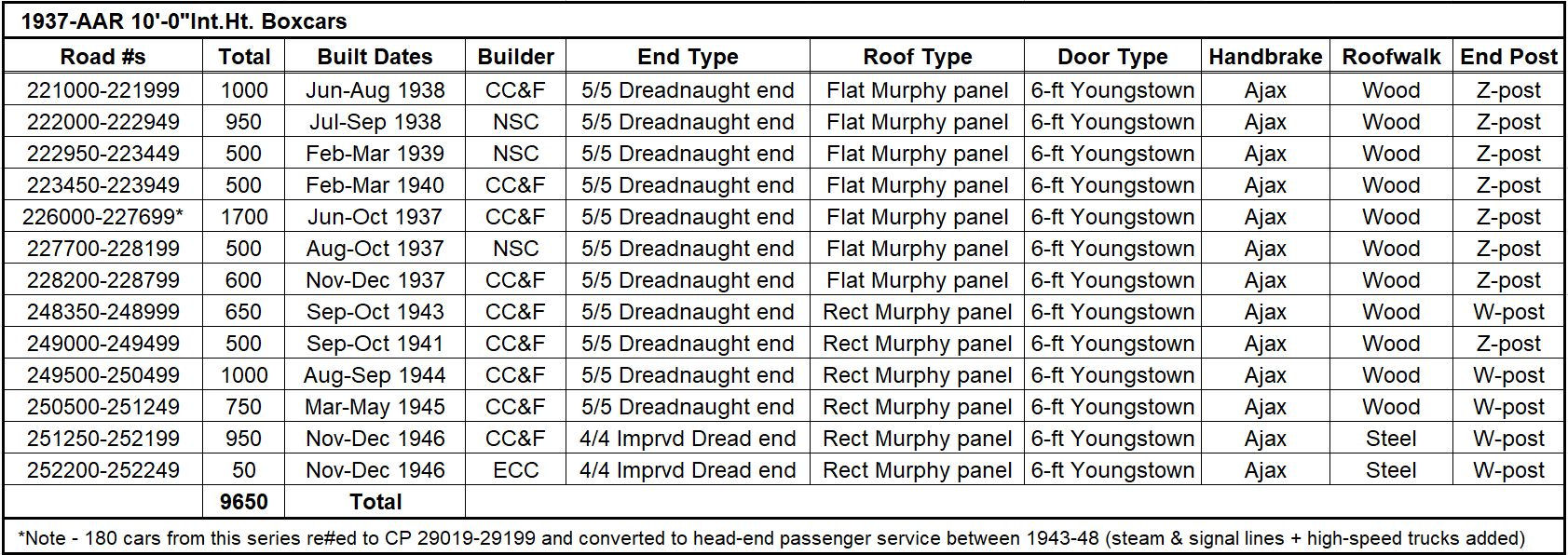
All time list of CPR steel 10′-0″ boxcars – (click to enlarge)
Though this essay deals specifically with CP’s steel-built 40-foot boxcars, it should be noted that steel restrictions during WW2 did force a brief return to wood cars. CP received three separate orders of 10′-0″ boxcars with wooden sides, all in 1943. NSC produced 200 cars (CP 239000-239199), along with ECC building an additional 50 (CP 239200-239249) all of outside-braced design, with steel Murphy raised-panel roofs, and 5/5-pattern Dreadnaught ends. CC&F played the innovator by building 500 cars (CP 223950-224449) of the 1937-design with plywood sheathing, both outside and inside, to test this new material. These would be the final wood cars received by the CPR. The war situation had improved by the end of 1943, and the CPR purchased 650 boxcars (CP 248350-248999) from CC&F by the end of that year, all of standard steel construction.
These final wood boxcars lasted in revenue service until the late 1950s, after which the outside-braced boxcars were converted into livestock cars (into series CP 277200-277499) by 1958, and the plywood cars (series CP 277500-277999) by 1959. These cars remained in this service right until the end of Canadian rail livestock movements in the mid-1980s.
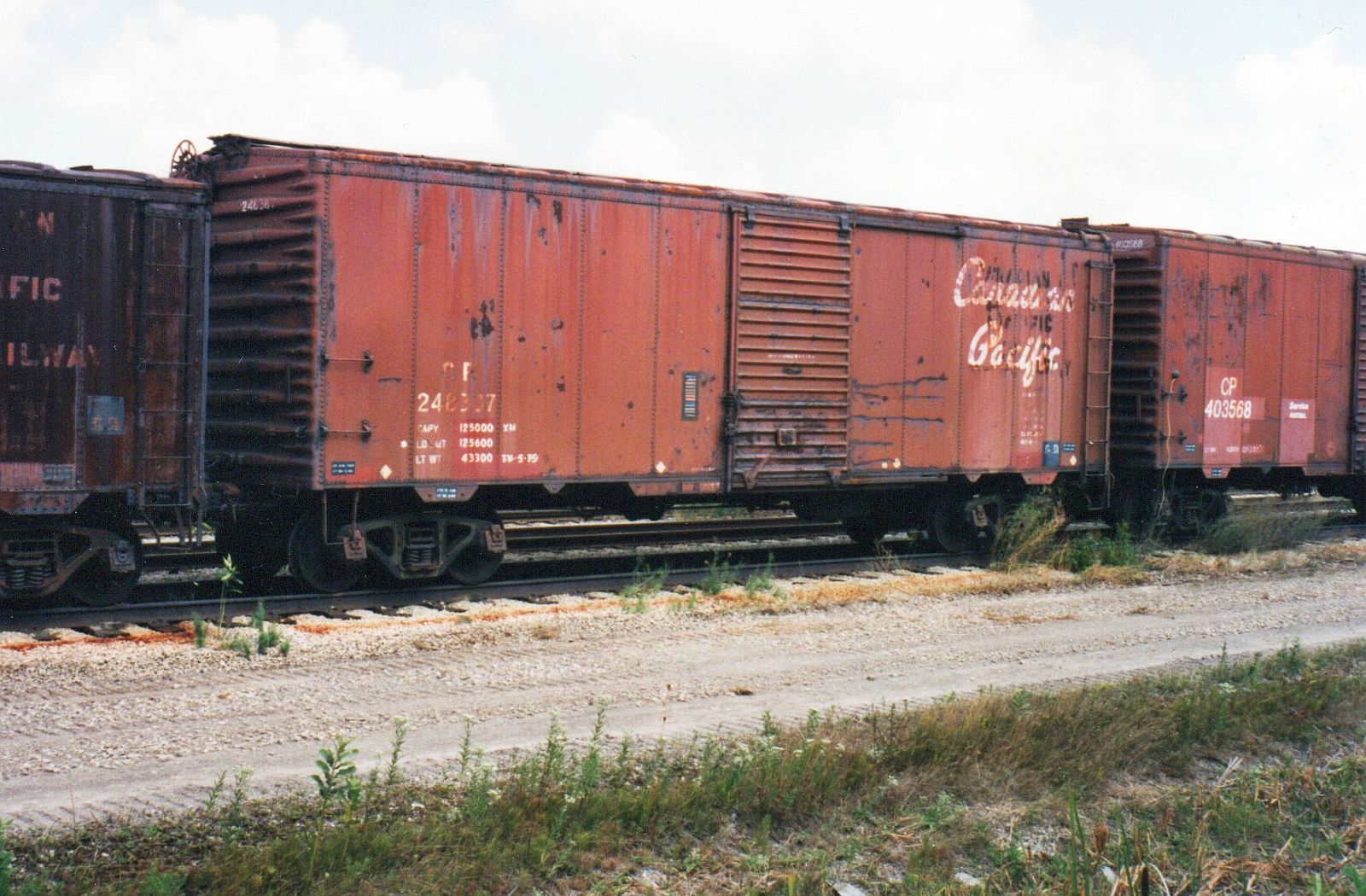
CP 248387 is a later 1937-style car (CC&F blt-1943) with a Murphy rectangular panel roof and W-post (rounded) end corners, but still sporting a wooden roofwalk from wartime steel restrictions. Photographed in Welland ON on 04 Sept 1995. (Ted Kocyla photo)
The 10’ 0” boxcars had a long life on the CPR, with the 1973 equipment register continuing to list 5824 of these cars on the roster in revenue service. The majority of these would have been hauling grain on light-prairie branchlines or utilized in other secondary services, but still a significant number within their entire 40ft boxcar fleet and a demonstration of their longevity. These cars lasted right until the end of the 40-foot boxcar era, and beyond. Up until the early 2000s there were still some surviving 1937-AAR boxcars employed by Canadian Pacific in maintenance-of-way OCS service, which is still a notable feat for a 70-year old design.
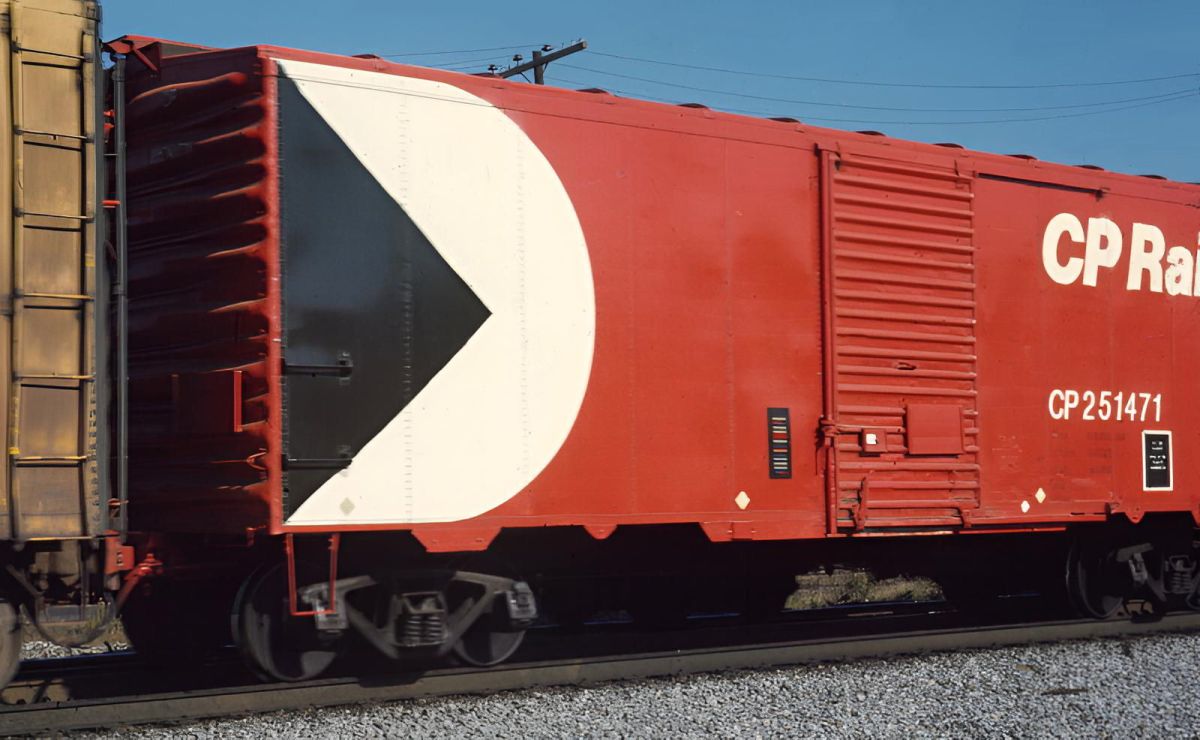
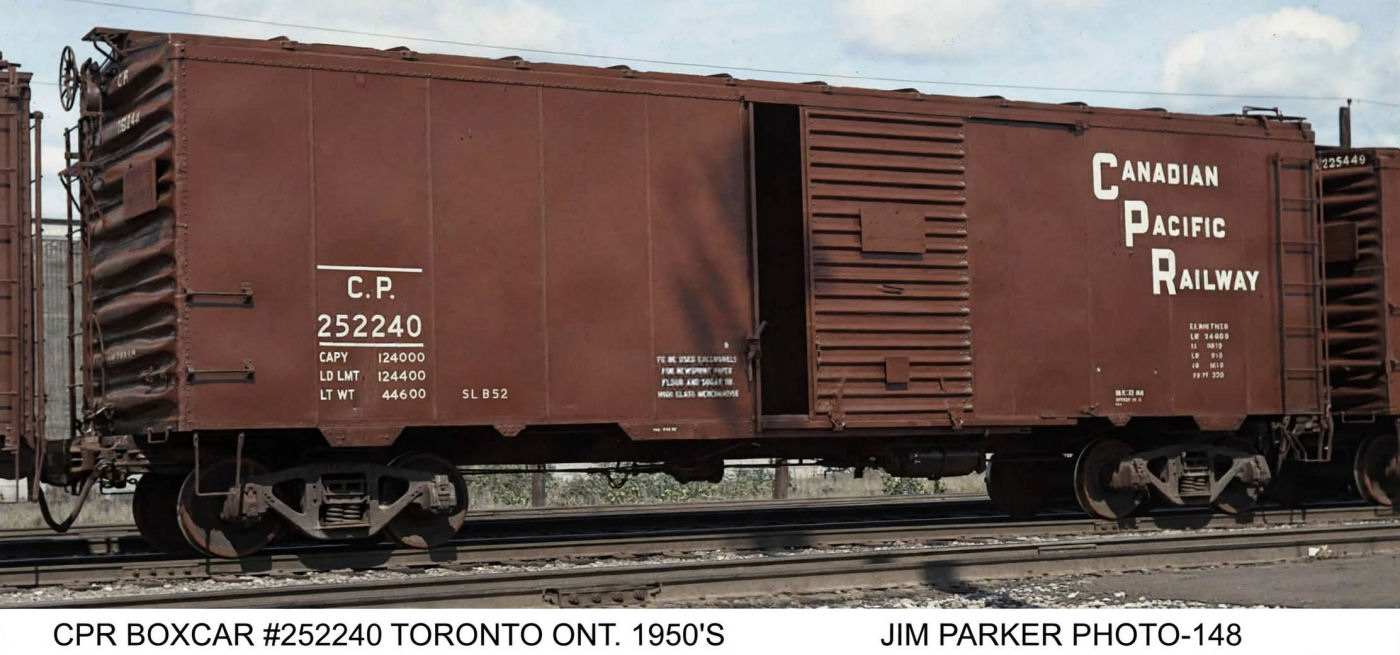
A harbinger of the future, the final two orders of 10′-0″ boxcars came with 4/4-pattern Improved Dreadnaught ends. CP 251471 (CC&F blt-1946) at Utica NY in Nov.1973. (Sal Suppa Photo)CP 252240 from the final order of 1937-AAR boxcars (ECC blt-1946). Note the steel roofwalk, rounded (W-post) corners, and 4/4 pattern Improved Dreadnaught ends. (Colourized Jim Parker photo)
CP 1937-AAR Boxcar Modelling Notes
Thanks to large numbers of 1937-AAR boxcars built for both the U.S. and Canadian railways, a number of model manufacturers have produced them in HO-scale over the years. The old, venerable Athearn “blue-box” 40-foot boxcar was based on this car, though coming from the 1960s it suffers from being out-of-scale in addition to its coarse, cast-on details.
For those willing to kitbash a good model kit, Intermountain (originally Innovative Model Works – I.M.W.X.) still offers an undecorated kit (prod# 40799) which works well for the later-built W-post cars with raised Murphy roofs. By adding either a 5/5-pattern Dreadnaught end (CP 249500-251249 series) or a 4/4 Improved Dreadnaught end (CP 251250-252249 series), the kit is a great starting point.
Branchline Trains (out of production) once offered this car in their “Yardmaster” series with cast-on detail parts. This old kit is cited because it is a diamond in the rough, and can be found at flea markets and train shows at reasonable prices. This model also has separate end-pieces, so shaving/sanding off the offending cast-on details is relatively easy, and replaced with separate ladder and grabiron detail parts. As with the Intermountain kit, adding the appropriate 5/5 or 4/4 pattern ends can render a later-built CPR 10′-0″ car.
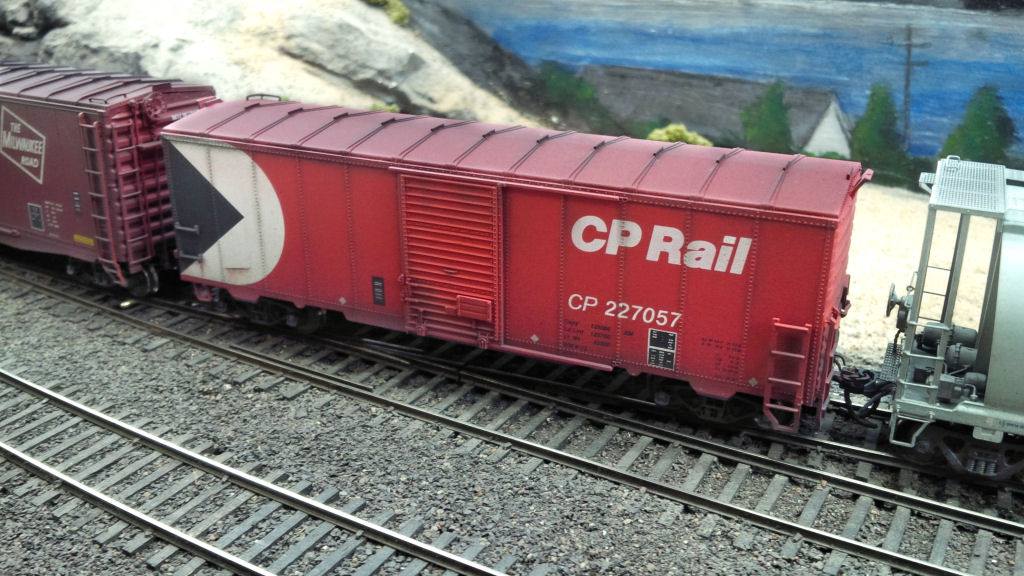
For modellers who are not comfortable with kitbashing, there were ready-to-run Canadian-specific 10′-0″ boxcars once produced by True Line Trains back in 2014. Though they are no longer in business, these model can still be found at many train shows, flea markets, and estate sales. These cars fill a hole for CPR modellers, as these were the early version boxcars with flat panel roofs and Z-post squared ends. There is also disappointment though, as T.L.T. did produce accurate W-post / raised-roof panel boxcars for CN and ONR modellers, but not the CPR versions.
A True Line Trains 1937-AAR boxcar model on the CP Sudbury Division layout. (WRMRC photo)
But there is good news for all Canadian modellers with Rapido Trains now producing the 1937-AAR boxcar in multiple detail-specific variations for many U.S. and Canadian roads, including Canadian Pacific. Oddly, their initial offering is for the same T.L.T.-produced early version CP boxcars with flat roofs and squared end corners, though Rapido does intend to offer more versions and paint schemes in future releases.
Regardless of the duplication, the Rapido boxcar is by far the superior model of the two, with the older T.L.T. model suffering from coarser details such as ladder, stirrup, and grabiron thickness. The Rapido model is also the first to render the segmented wooden roofwalk properly. So whether you’re on a budget (kitbashing/TLT) or demand perfection (Rapido), as far as 10′-0″ boxcars are concerned, CPR modellers have options.
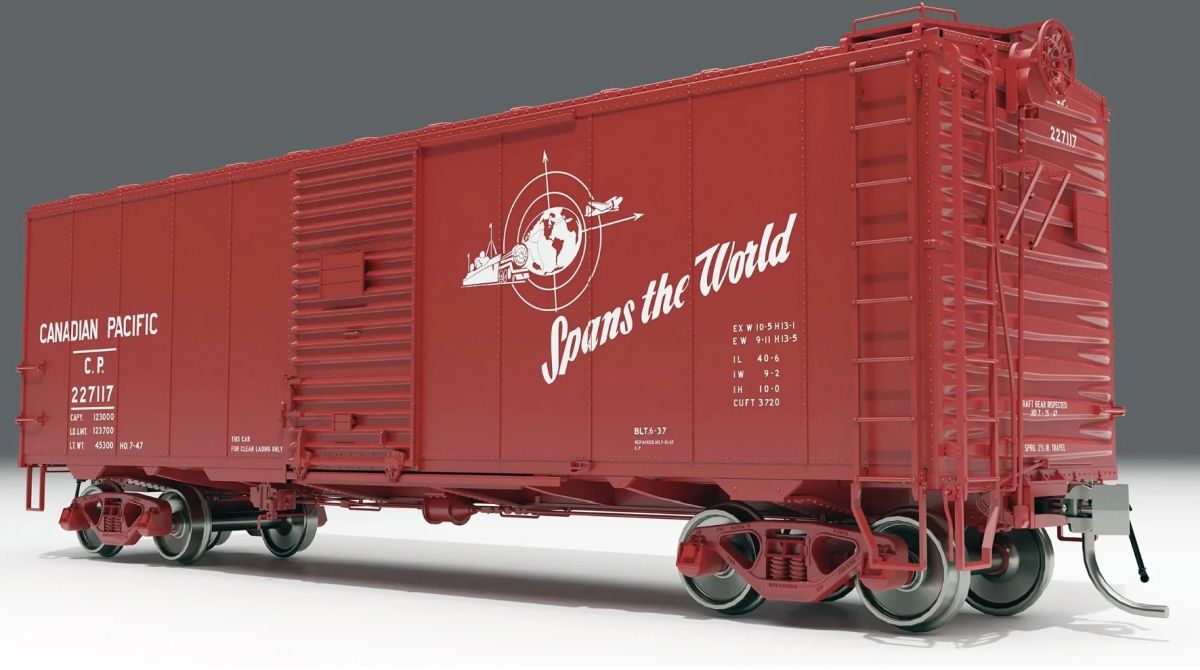
Rapido Trains 1937-AAR boxcar model in CP’s attractive, but short-lived ‘Spans the World’ scheme. (Rapido Trains photo)
References:
“Canadian Pacific’s 40-foot Steel Boxcars” by Jim Little, Railroad Model Craftsman – Oct.1994 – pg 81-89