The Sudbury Ore Car Fleet

It was during the construction of the CPR during the 1880s that copper ore was discovered and sparked a flurry of mineral exploration and mining claims. Since then, Sudbury has been known as a major mining and smelting centre, producing not just copper but becoming a world leader in the production of nickel. As the new railway opened up accessibility to the mineral resources in the area, many mining and smelting companies were incorporated such as The Canadian Copper Company, Mond Nickel, British America Nickle Co. (BANC), Dominion Nickel, International Nickel Co. (INCO), and Falconbridge Nickel.(The first four would later be absorbed by INCO to become the major player on the Sudbury scene.)

Much of this ore would be moved between the mines and the smelters by rail, so transport of both ores and finished products is a major part of the rail scene in the Sudbury area. The mining companies had their own private railways connecting some of the mines, and other mines were served by the “common carrier” railways: Canadian Pacific, Algoma Eastern (later part of CP), and Canadian Northern (later Canadian National).

Sometime around 1910, the Hart-Otis Car Company of Montreal patented a drop-bottom gondola design, whereby doors in the floor of the car could be operated by geared handles on the ends of the car to discharge its load to the sides of the track, which would quickly become popular across Canadian railways with short steel versions of these cars being adopted as the standard car for shipping raw ore for INCO in the Sudbury region.

The Pre-1920 CC&F Cars
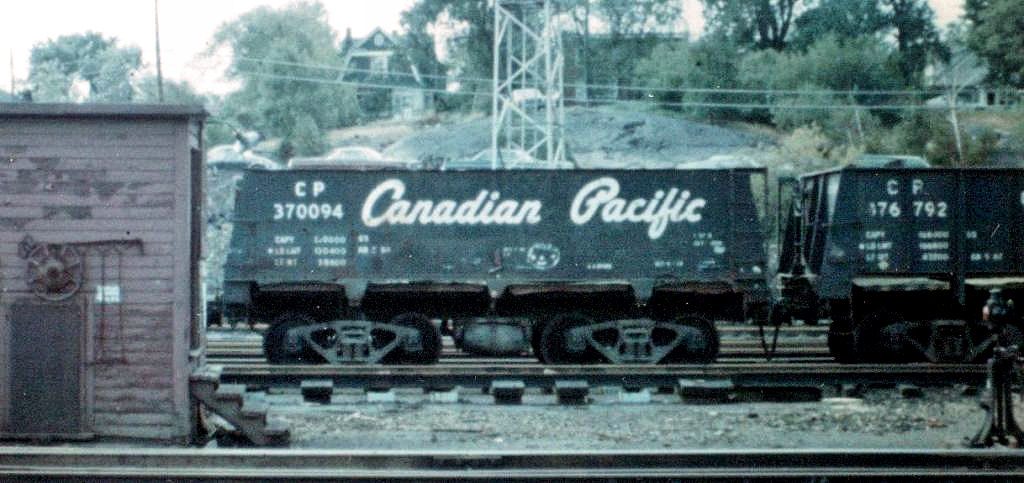
cp370094u

CP 370094 was built in 1916 as part of the AE 2801-2925 series and renumbered to CP around 1932. John Brown photo (WRMRC collection), 1970.

The early Hart-Otis design cars used by INCO were a 22’5″ interior length car with 4 drop-bottom doors on each side. Interior bracing give the cars a nice smooth-sided appearance. Canadian Pacific, Canadian Northern (later Canadian National), Algoma Eastern, and INCO themselves all rostered cars to this basic design and size. (When CP went to a larger car size as we will see below, CN and INCO continued to also use cars of this smaller size at some of their operations.)

The CP cars were built (probably by Canadian Car & Foundry in Montreal) in three batches totaling 200 cars between 1914 and 1919. Another 125 were built for the Algoma Eastern, which would later be transferred to CP in the early 1930s after CP leased the AER and absorbed its operations. An unknown number of identical cars were also owned by INCO.

By the 1970s only a tiny handful of these older cars would still survive.

Series #Cars IL Builder Date Note
CP 370000-370124 125 22’5″ CC&F 1916 ex-AE 2801-2925 /32
CP 371200-371239 40 22’5″ CC&F? 1914
CP 371240-371259 20 22’5″ CC&F? 1916
CP 371260-371399 140 22’5″ CC&F? 1919

The 1926-1930 CC&F Cars

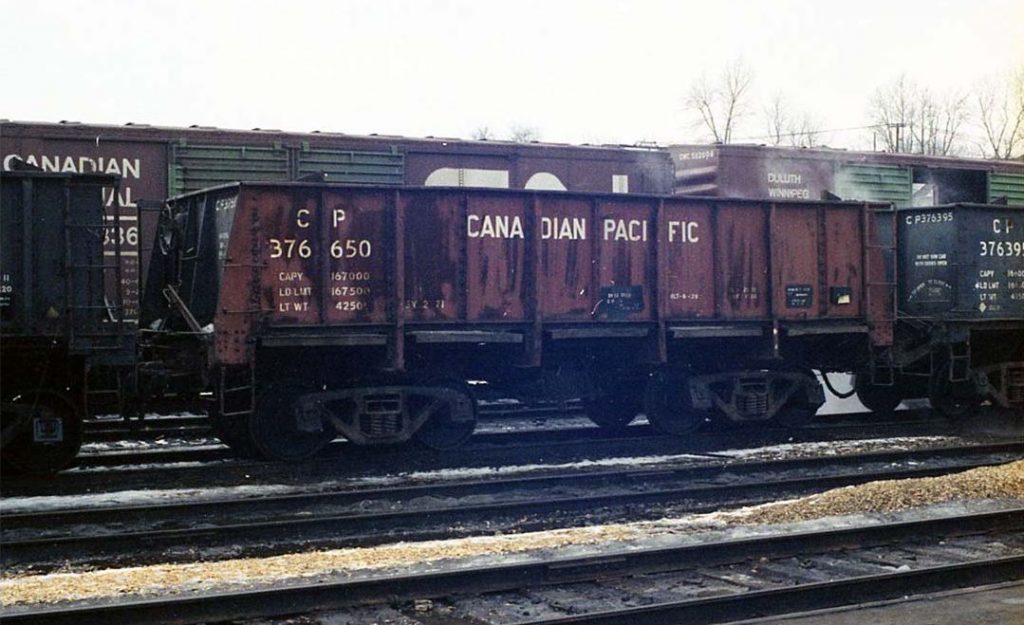
CP 376650

CP 376650, built in 1929 by CC&F, at Sudbury yard. Jim Parker photo, sometime in the 1970s.

Between 1926 and 1930 Canadian Car & Foundry (CC&F) built 350 cars (in three batches) for Canadian Pacific to a larger size of 25’11” interior length. The extra 3’6″ of interior length provided an increase of approximately 200 cubic feet over the previous cars and would become the standard ore car size for all new deliveries going forward.

The buttressed ends and riveted Z-shaped side bracing give these cars a rather distinctive appearance among the CP ore car fleet.

In the early 1940s, a number of the cars from this group were rebuilt with side extensions to raise the internal height and add another approximately 300 cubic feet of capacity for service hauling crushed quartz out of INCO’s Lawson Quarry, which began production in January 1942. Other cars from this group were rebuilt in the mid 1970s to convert them from drop bottom to solid bottom cars, which will be mentioned again later further down in this article. A few remained in more or less original condition until retired in the early 1980s.
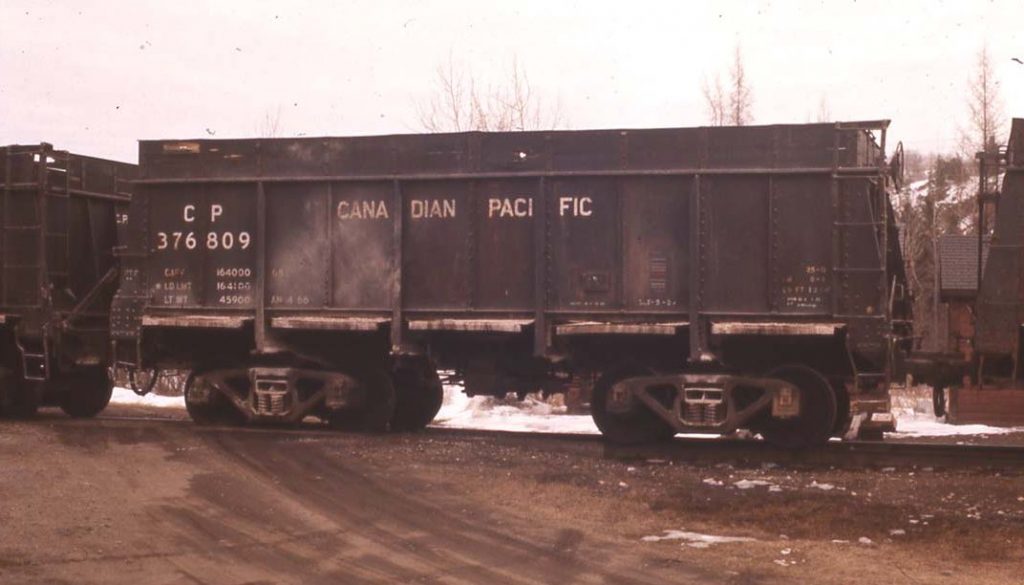
CP 376809

CP 376809, built in 1930 and rebuilt with side extensions in the 1940s for quartzite service. Jim Parker photo, April 1973.

Series #Cars IL Builder Date Note
CP 376500-376599 100 25’11” CC&F 12/1925-1/1926
CP 376600-376699 100 25’11” CC&F 9-10/1929
CP 376700-376849 150 25’11” CC&F 6-7/1930

The 1942 NSC Cars

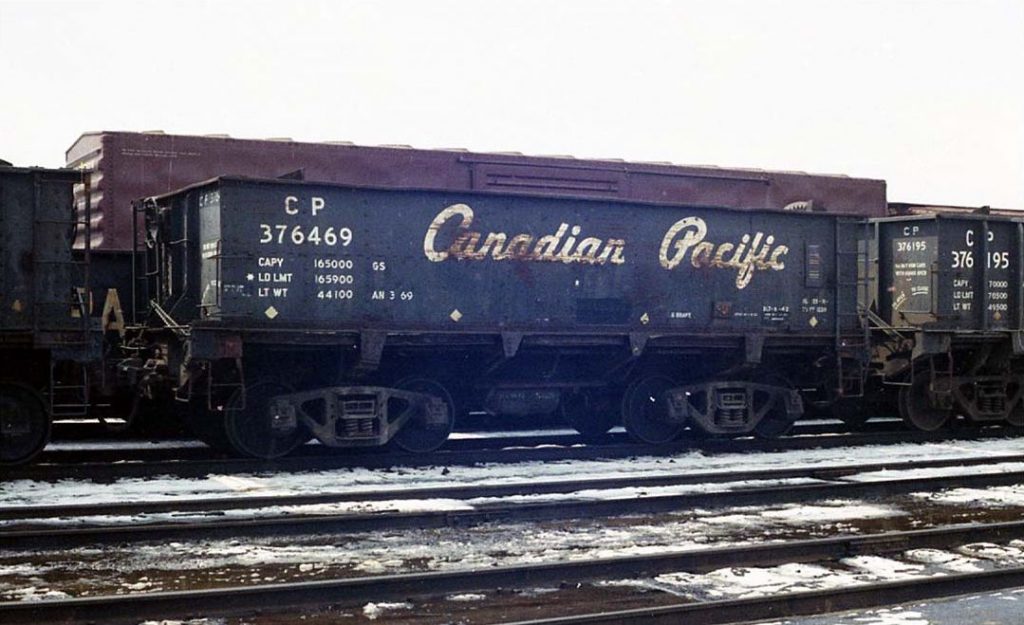
CP 376469, built 1/1943 by National Steel Car. Jim Parker photo, sometime in the 1970s.

The next batch of new cars acquired by CP were built by National Steel Car (NSC) of Hamilton, Ontario in late 1942, replacing cars that had been transferred to quartzite service (see above). Similar in overall size specifications to the previous 25’11” cars built by CC&F, interior bracing gave these cars a smooth sided appearance similar to the early pre-1920 22’5″ CC&F cars, but unique among the larger 25’11” cars.

While delivered many years before the Canadian Pacific “script” logo and paint scheme was debuted, the smooth sides lent themselves nicely to repainting with this lettering, and by the 1970s it seems most photos of these cars show them repainted in the 1960s script.

Series #Cars IL Builder Date Note
CP 376350-376499 150 25’11” 11/1942-1/1943 NSC

The 1956-1967 CCF/ECC Cars

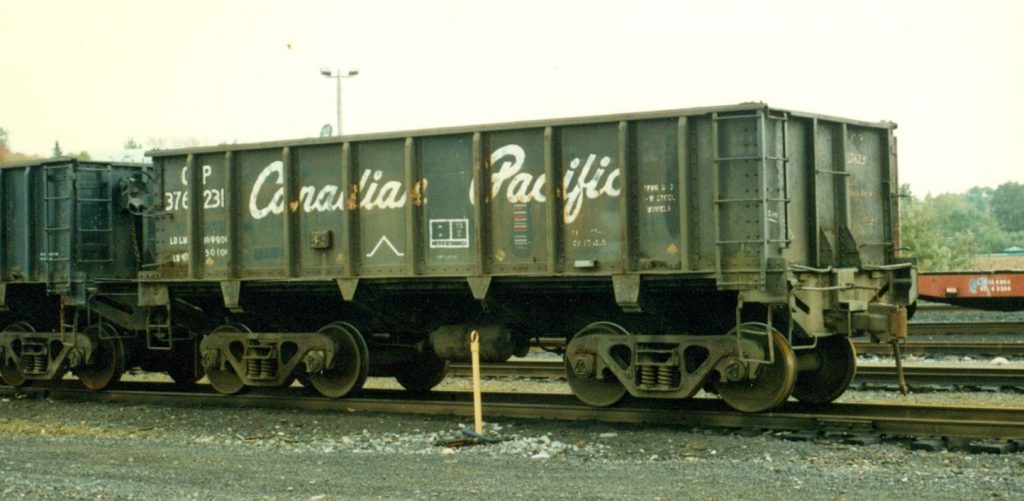
CP 376231

CP 376231, built 1967 by Hawker-Siddeley Transportation. Jurgen Kleylein photo, late 1990s.

In the late 1950s, CP expanded their ore car fleet again, with orders in 1956 and 1957 to CC&F and Eastern Car Co. (ECC) of Trenton, NS for 2 virtually identical groups of 100 cars from each builder. Another 60 identical cars from Hawker-Siddeley Transportation (HST), ECC’s successor company, were added on in 1967. These groups of cars were numbered above and below the existing number series for the 1926-1942 cars.

These cars feature riveted body construction with heavier external bracing compared to older cars. The 1967 order would have been the first (and only) ore gondolas to be delivered in script lettering from the factory. The 1956-57 built cars would have been almost identical construction, but painted in the block lettering scheme.

Series #Cars IL Builder Date Note
CP 376190-376249 60 25’11” HST 8/1967
CP 376250-376349 100 25’11” ECC 10/1957
CP 376900-376999 100 25’11” CC&F 11/1956

The 1970 HST Cars

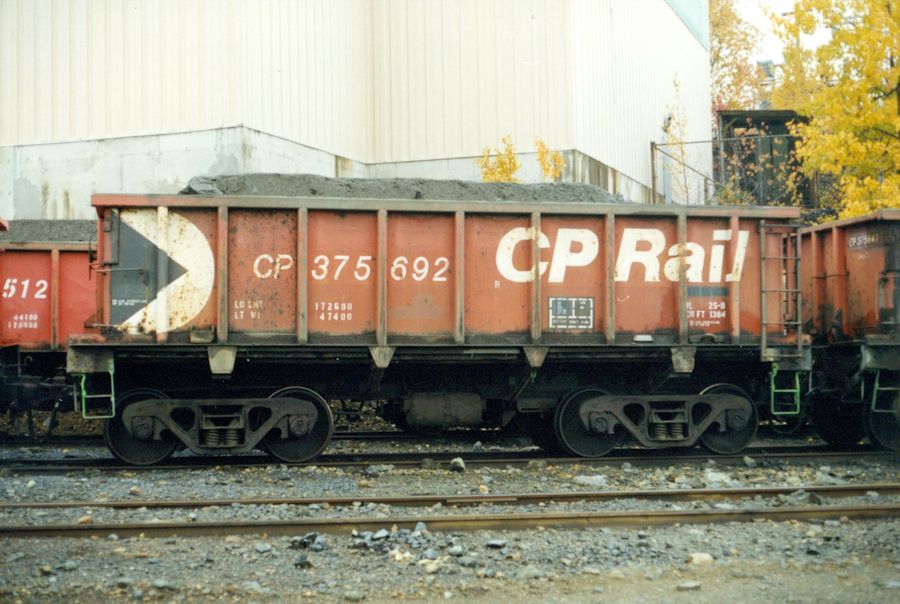
CP 375692

CP 375692 built in 1970 by Hawker-Siddeley. Jacques Richard photo.

CP’s last order of ore gondolas was this 200 car group built by Hawker-Siddeley in November 1970. While extremely similar to the previous cars built by ECC/HST, these are distinguished by being the only all-welded ore cars (the previous cars being of all riveted construction), and the only group of cars to be painted in the CP Rail “Action Red” paint scheme with the iconic “MultiMark”.

Sylvan Scale Models made a resin kit for this car.

Series #Cars IL Builder Date Note
CP 375500-375699 200 25’11” HST /1970

The “Tight-Bottoms”

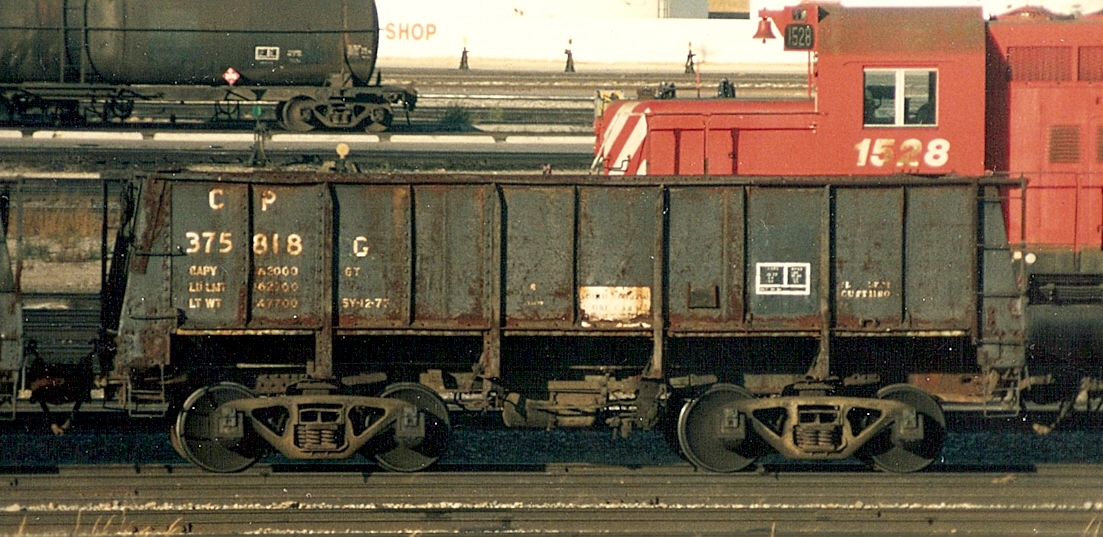
CP 375818 1926-1930 built CC&F ore car rebuilt with solid floor, retired and awaiting scrapping at Winnnipeg, August 1985. Fred Shannon photo.

In the mid-1970s, INCO installed a rotary car dumper at their smelter facility in Copper Cliff, converting to rotary rather than bottom dumping. Some 200 cars originally built between 1926-1942 were rebuilt between 1973 and 1979 to remove the bottom doors and replace them with a solid steel floor. These rebuilt cars were selected and renumbered rather at random into the 375800-375999 series and colloquially known as “tight bottom” ore cars.

Many of the newer cars built after 1956 would later simply have their bottom doors welded shut and door operating levers removed to convert them to “tight-bottom” cars and retain their original numbers, which can actually be seen in the photo of CP 376231 above, which lacks its door operating levers, the doors having been welded shut.

Series #Cars IL Builder Date Note
CP 375700-375799 0 25’11” n/a n/a planned but never filled;
shows in some 1970s ORERs
CP 375800-375899 100 25’11” var. 1926-1942 ex 376350-376499 &
376500-376849 /73-/77
CP 375900-375999 100 25’11” var. 1926-1942 ex 376350-376499 &
376500-376849 /77-/79

The Falconbridge Slurry Cars

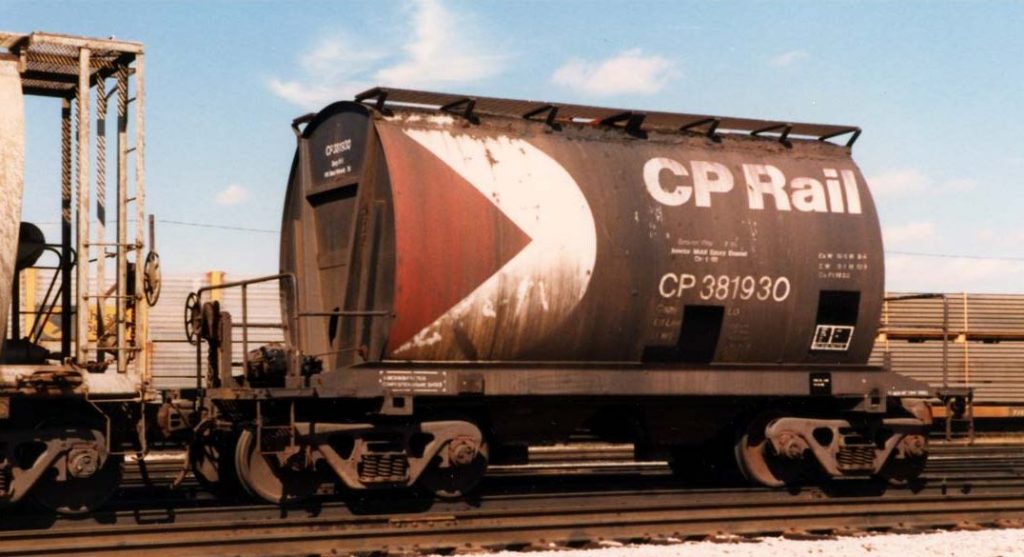
CP 381930

CP 381930, built 1969 by Davie Shipbuilding. Bill Grandin collection photo.

Last but not least, we leave INCO behind and head over to competitor Falconbridge Nickel for something completely different. In the late 1960s, Falconbridge decided to ship concentrated ore as a slurry (finely crushed and mixed with water) between their mine and mill near Levack to their smelter at Falconbridge to the east of Sudbury. To ship this ore slurry, CP acquired a group of very unique cylindrical hopper cars that were dedicated to this service between Levack and Falconbridge. These distinctive cars were built in two separate batches in 1967 (delivered in script paint) and 1969 (delivered in Multimark paint) by Davie Shipbuilding. Since rainwater mixing with the slurry wasn’t considered an issue, the openings at the top of the car did not have covers.

The ore slurry was abrasive to the interior of the cars, and with the cars wearing out in the late 1980s Falconbridge switched to shipping by truck and the slurry cars were retired. A few survived however, being used as scale test cars by CP.

Sylvan Scale Models made a resin kit for this car.

Series #Cars IL Builder Date Note
CP 381900-381919 20 19’5″ Davie 12/1967
CP 381920-381959 40 19’5″ Davie 9-10/1969

WRMRC Fall Open House – Saturday 15 October 2022

On Saturday, 15 October 2022, the Waterloo Region Model Railway Club cordially invites you to our Fall Open House to visit the CP Sudbury Division layout. This is the first time our club will be open to the general public since the COVID pandemic.

img_2773.jpg

The layout be open from 10:00 AM to 5:00 PM. Feel free to invite any friends or family members interested in model railways, and plan on staying a while to see what’s new.

For maps and more information visit our WRMRC website, or our Facebook page.

X5025E_LaSalleBlvd

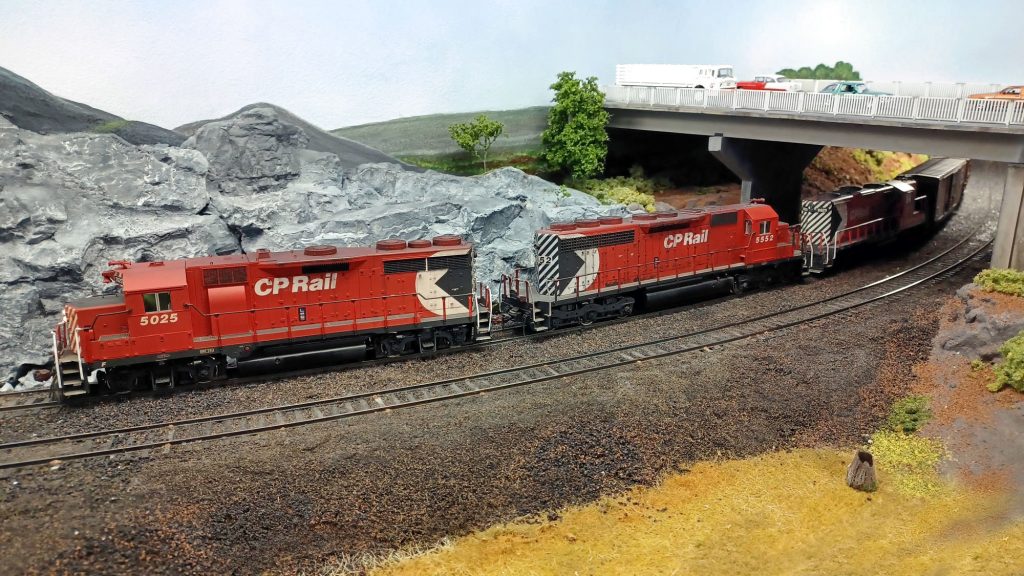
Extra 5025 East rolls under the LaSalle Blvd bridge on the CP Sudbury Division Layout.

Admission:

  • Adults: $5.00
  • Seniors and Students: $3.00
  • Children (12 and under) are FREE, but must be supervised by an adult

2022 Virtual Tour Video

For your viewing entertainment, our club is sharing what we hope will be our last ever virtual layout tour video.

To give some background, this was prepared as our submission for the 2022 Doubleheaders Tour last March, and features absolutely no (zero / nil / nada) trains operating. This was because every past video we’ve produced shows practically nothing other than trains running, and we wished to do something more instructive and completely different this time around. So sit back, grab a beverage, and listen as WRMRC VP Ted Kocyla  bores  enlightens you for 23 minutes about what the club has accomplished over two years of pandemic restrictions.

VidPreview01

https://drive.google.com/file/d/1eNgZkcBe98r-EzmWHKptGvwZUZB4Xkxw/view?usp=sharing

If nothing else, this video helps us advertise all the new things you can see at our upcoming Fall Open House, where we hope everyone can visit us in person again. Stay tuned for more information about that. But for now, this video will have to do.


Virtual Doubleheaders Tour 2022

This weekend, from 9am Saturday March 26th to 9pm Sunday March 27th 2022, the Doubleheaders will be hosting a free, online Kitchener-Waterloo-Cambridge-Guelph model railway tour. The tour features a number of great home and club layouts from the area that you’re sure to enjoy.

The CP Sudbury Division Modellers will be participating again this year, with a new video featuring the recently added structures, new scenery and CTC signalling progress that the WRMRC has made through the COVID pandemic.

This year the presentations will be posted as YouTube video links available on the Doubleheaders Facebook page, in addition to their main website.

With all videos being available throughout the weekend, this virtual experience will be more like the traditional home/club tour where you are able to view the layouts according to your personal schedule, and in any order.

For further information, please email:

dhtour at gmail.com (all together, replacing at with @)

 5559_Sprecher

2021 Open House Cancelled

Due to Ontario being stuck in phase-3 of COVID reopening, it is with reluctance that the WRMRC executive has decided to cancel our 2021 Fall Open House which was scheduled for October 16th this year.

We had been procrastinating and hoping for better news from the province, but with the occupancy conditions currently in place our club could not reasonably hold a public event.

Phase-3 conditions require us to cap the capacity within our Quonset hut to 25 people, which would have to include the ten or so members volunteering to guide visitors and operate trains. Despite any limit our aisle-ways would prevent proper social distancing, and that cap would obviously cause line-ups before entry. There was also the matter of Ontario’s new vaccine passport system, something we would need to enforce and that none of us wish to police.

In closing, our club recommends you protect yourself and others by following the medical advice of your doctor, and to be vaccinated if you are able to. It is the only way forward for society to return to normal, and for train shows to happen again.

We are hopeful this will all be resolved by the end of March for our club to participate again in the 2022 Doubleheaders Layout Tour, and of course we fully expect to hold our Fall Open House again next October.

Stay safe and stay healthy.

Kitbash Free Or Die

or: How to Salvage a McKean PS-1 Kit and Create a Cool New England Boxcar

NSRC458_01

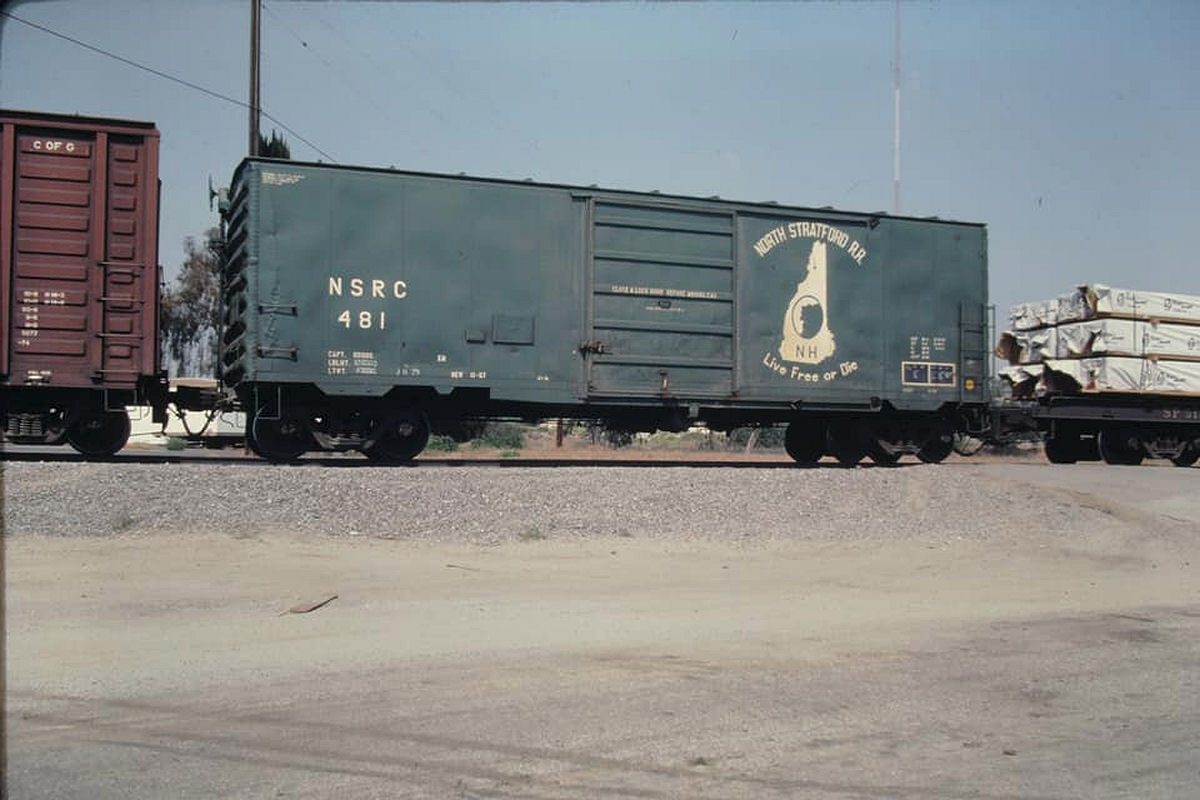
NSRC 481, a typical North Stratford Rail Corp 40ft PS-1 boxcar, was photographed rolling through Pomona, California on 07 June 1982. – Tim Brooks photo (courtesy canadianfreightcargallery.ca)

This latest project originated from an evening bout of model train show withdrawal symptoms, as the lack of flea markets and swap meets during the pandemic restrictions caused me to review my boxes of surplus models. There I re-discovered all the old McKean and Front Range rolling stock kits that I’ve been offering for sale over several years worth of Kitchener Train Shows.

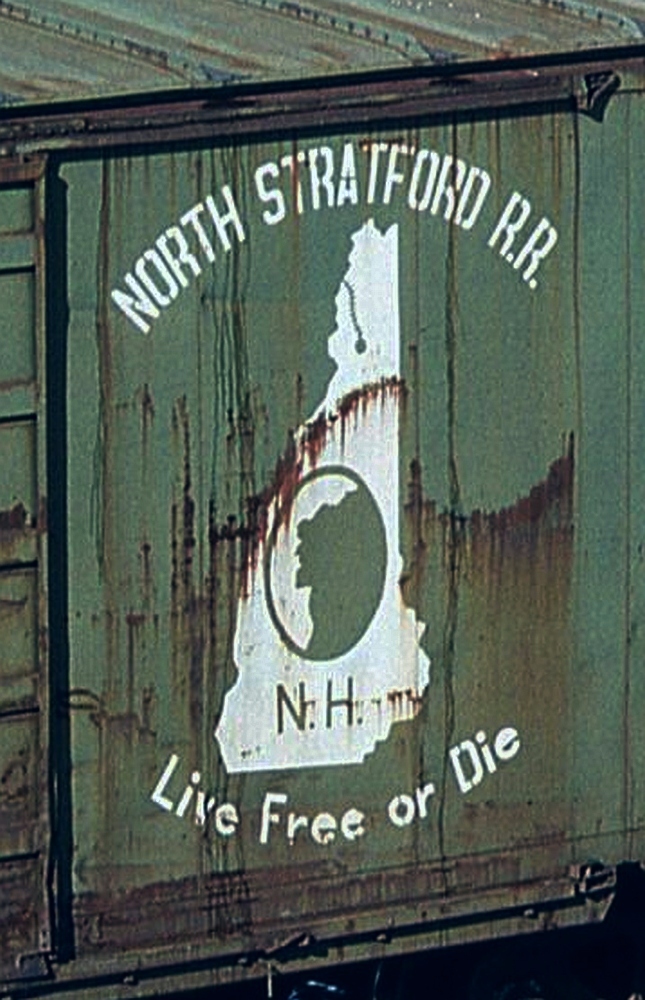
NSRC_logo1Looking over these kits my mind began to meander and imagineer various modelling possibilities, somehow wandering back to the late 1980s where I recalled seeing North Stratford RR boxcars rolling though southern Ontario. They were curiosities back then, not only because they were probably the last 40-foot boxcars still in interchange service, but from their bold logo and distinctive ‘Live Free or Die’ slogans (the state motto of New Hampshire). But then I remembered the kitbashing involved to get these kits up to modern modelling standards, and reasoned there must be some manufacturer out there that produced a good ready-to-run North Stratford RR boxcar.

Well a quick internet search found there were none, but there were decals available for the project. That caused more research on the real North Stratford Railroad, and whether the WRMRC’s CP Sudbury Division layout could see any of their boxcars. The short answer was yes, which caused me to pull an 8-foot door undec McKean kit from the surplus box, followed by an online decal purchase. The kitbash was on.

NSRC458_02

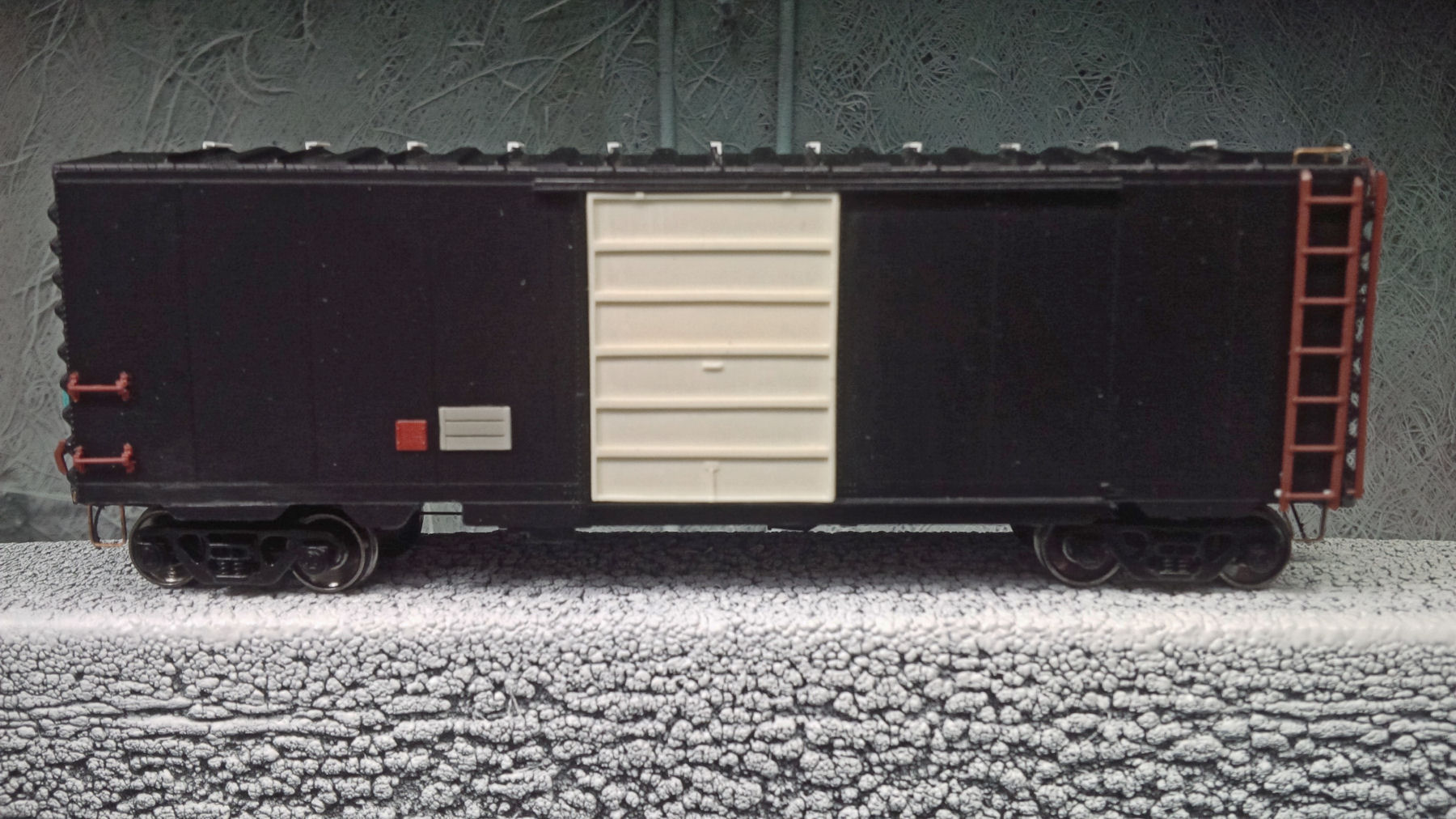
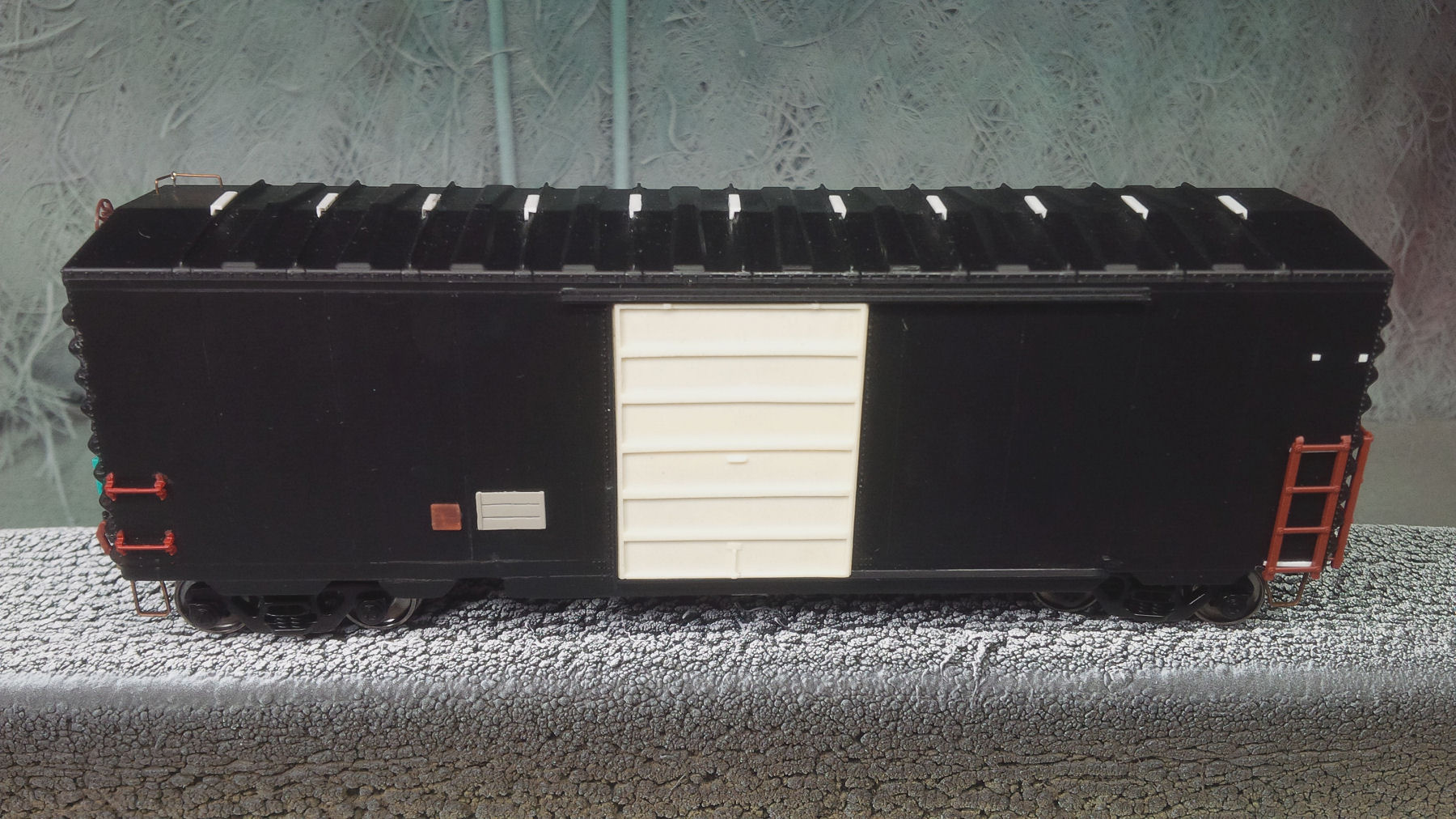
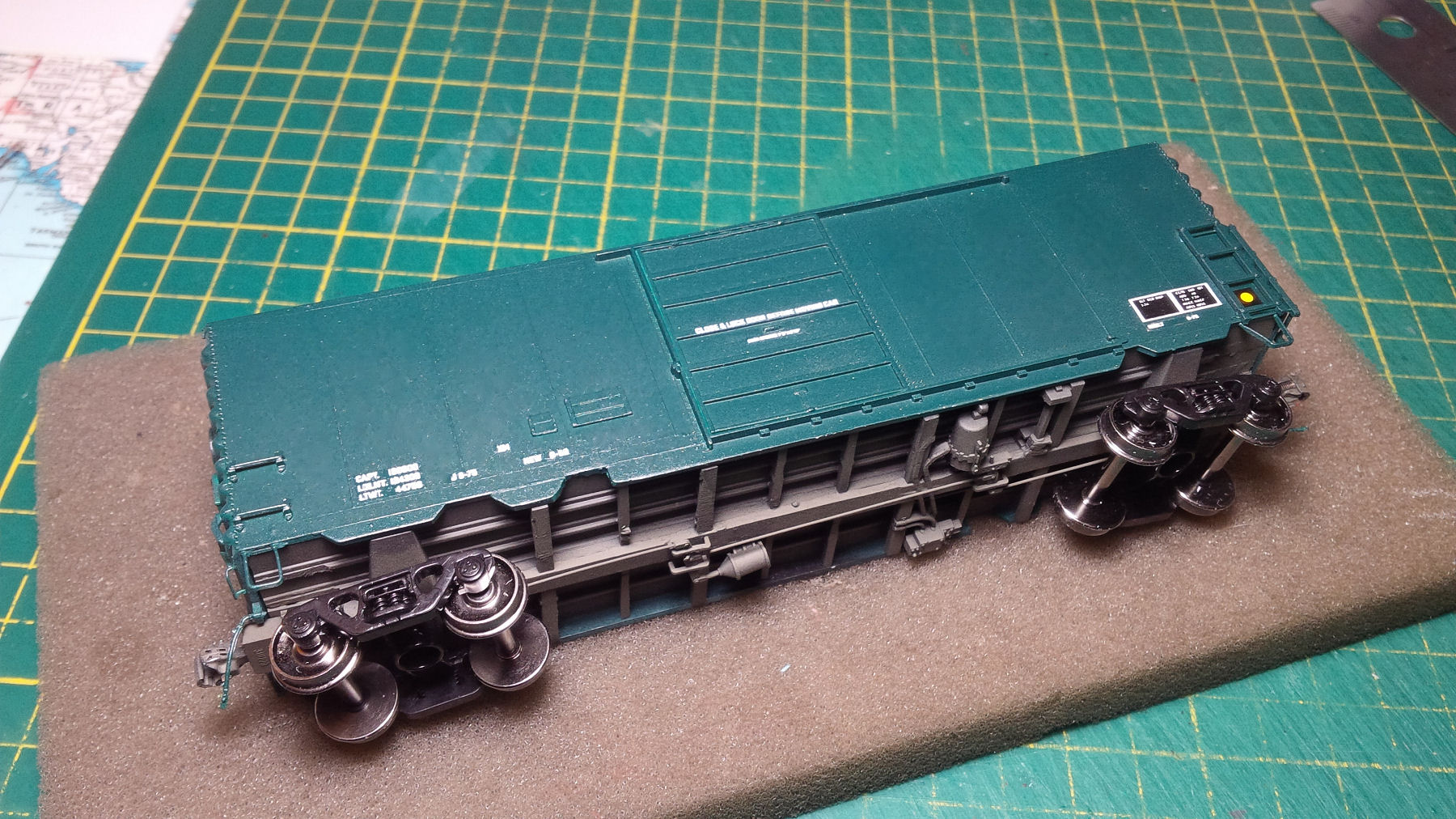
Left-hand (tall-ladder side) view of the kitbashed McKean model, ready for primer. You pretty much have to toss all the manufacturer-supplied details when bashing these old 1980s kits.

A brief history of the North Stratford Railroad can be found on their Wikipedia entry, and a Google search will provide you with plenty of information if you wish to learn more. From this research, for the purposes of club operating sessions, it was plausible that NSRC boxcars could be hauling furniture from the former Ethan Allen furniture factory in Beecher Falls VT to the greater Chicago area over the CP Sudbury Division. CP trains 911/912 captured a lot of New England – Chicago bridge traffic through the 1970s, as shippers used whatever means possible to avoid the lengthy transit times caused by the Penn Central merger mess.

I’ve written before about my old kit salvage jobs, specifically here and here. Basically my goal is not to create a contest model, but to make a reasonable representation utilizing the many boxes of spare parts I’ve accumulated over the years. The challenge is to create a boxcar that will not melt if coupled between a Kadee and Tangent model, and not to spend any extra money aside from decals and maybe paint.

NSRC458_04

Right-hand (shortened-ladder side) view of the model. The various detail parts used came from the author’s spare parts collection. Roof-walk and ladder supports were fabricated from styrene.

Before you copy my work, please note there was a mistake made because I began kitbashing the car before thoroughly researching the prototype. Bashing enough of their kits over the years, I habitually began by adding the roof walk supports that McKean inadvertently missed on their model. This was done using .060” styrene angle, chopped to the appropriate length, and glued on the roof rib peaks. After doing this I came across a good roof-view photo of an NSRC boxcar, and discovered the roof had been completely rebuilt with no roof-walk supports. It turns out their entire fleet of 100 reconditioned 40-foot boxcars had rebuilt roofs. So I actually went out of my way to goof this boxcar up. Oh well, good thing this isn’t a contest model.

As for the other details utilized, most came from my collection of left-over parts from old Intermountain, Branchline and Proto-2000 models purchased over the years. The ladders, grab irons, and tack boards were all surplus left-overs from those kits. The 8-foot Superior doors were excess parts from a Sylvan Scale Models double-door boxcar kit. I never throw any good spare detail parts away. Additionally there were some wire 18” drop grab irons on the car ends, and a a wire corner-grab on the roof utilized also. I often re-bend staples to create new metal stirrups on my kitbash projects, but went the easy route and used A Line Products stirrups on this one.

NSRC458_03

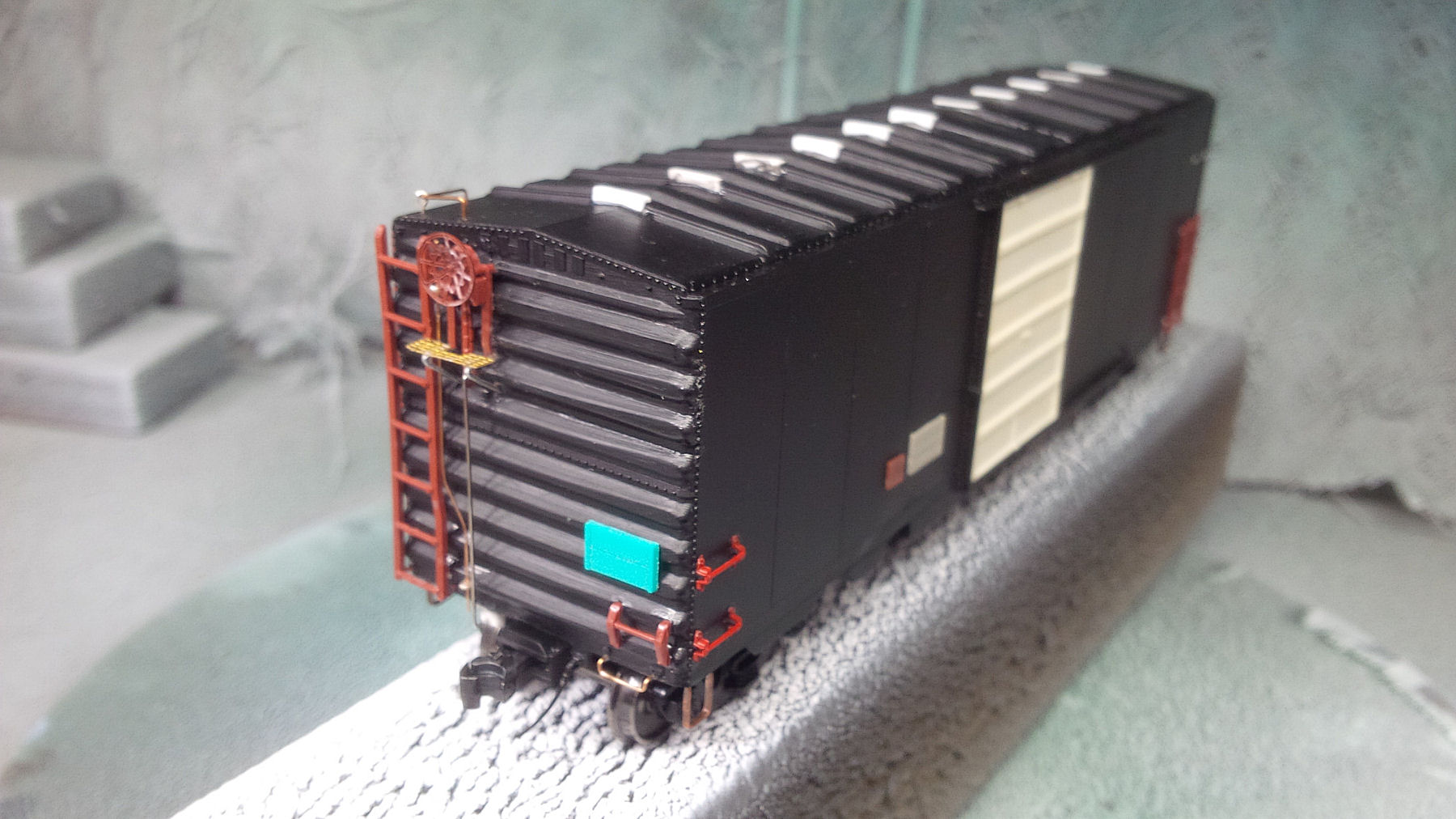
‘B’-end view. The McKean brake housing was salvaged, but with a Kadee brake wheel and metal wire used for the brake and air lines. A couple of re-bent staples support a Details Associates photo-etched brake platform. That jade green tack-board must have come from an old NYC kit.

They might have been good for their time, but the underbody on these McKean kits needs a lot of work too. First I body-mount scale #158 Kadee couplers in their own boxes (nothing works better than a Kadee in it’s own box), which requires you to remove the molded-on McKean coupler housings. Doing so will expose a square hole which needs to be filled with styrene. After that’s plugged you can drill and tap a #2-56 screw to mount the replacement Kadee coupler boxes.

NSRC458_05

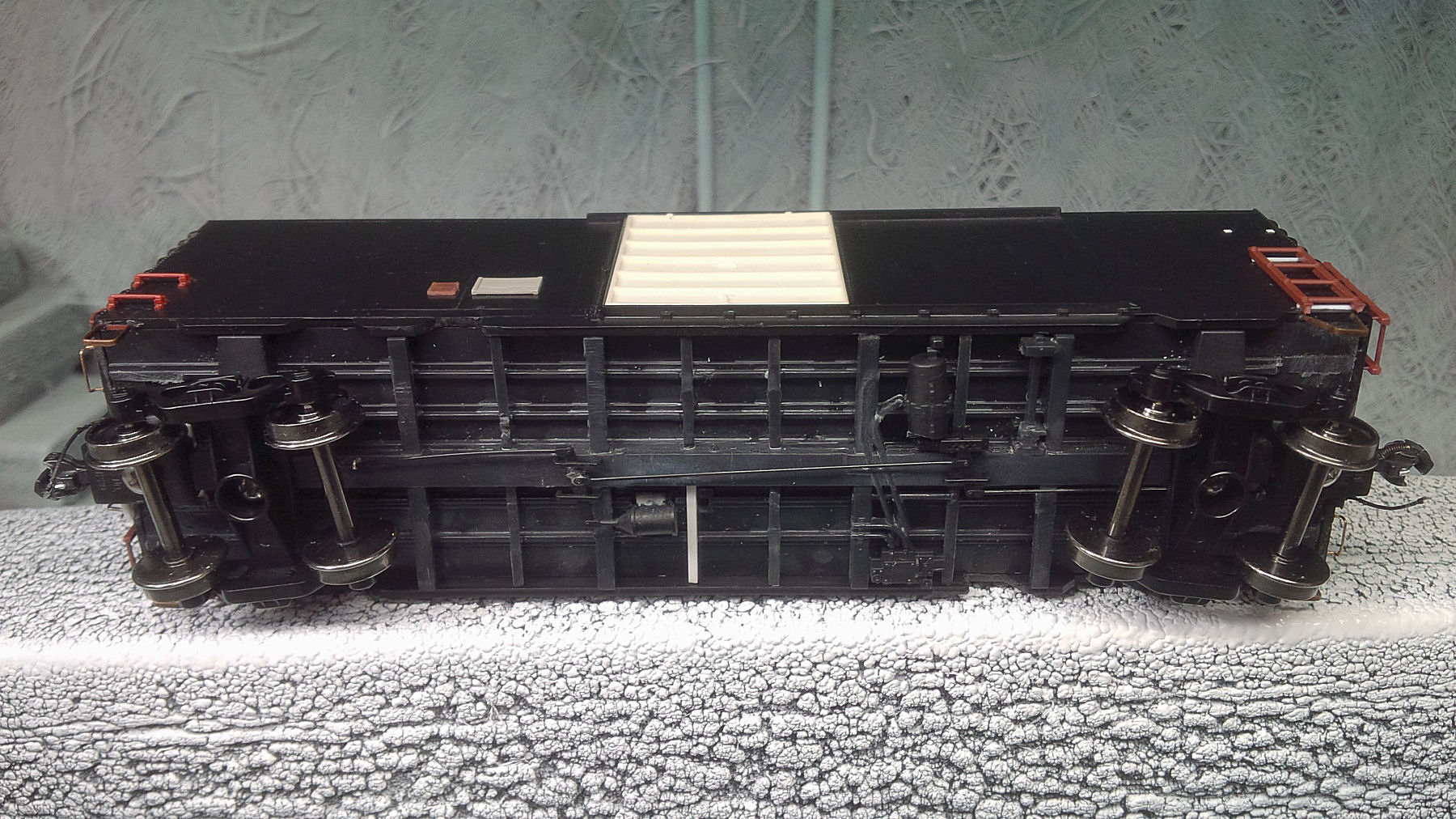
Underbody view. Most of the original details were cut away, and a new Accurail 1-piece underframe brake rod set was installed. Kadee #158 scale couplers were also added.

Though the underframe brake rods look complicated, they are actually very easy to add. The hard work was cutting away most of the old McKean details in order to add them. Once that was all done and cleaned, I installed an Accurail one-piece underframe brake rod set which gives your model the appearance of having a super-detailed underbody with minimal effort. To finish, I installed a set of 50-ton roller bearing trucks equipped with Intermountain 33” wheels. All the NSRC 40-foot PS-1 boxcars rode on these style trucks.

In order to blend together all the different coloured detail parts before paining, the model was first primed with light grey Tamiya Fine Surface Primer.  Yes, right from a rattle can, and you get a wonderful finish. I then looked for whatever green the WRMRC paint collection had that best matched these NSRC boxcars. Photos show a dark green / bluish colour when new, fading to a lighter, truer green as they aged. Needing to replicate a nearly new car I chose PolyScale F414188 CNW Green, unfortunately now long out of production. If you need help, I’m certain the CNW modellers know of a good replacement paint match. I then sprayed Tamiya clear gloss coat, as PolyScale paint is flat and a gloss finish helps with decal adherence.

NSRC458_06g

In progress photo of the decal application. K4 Decals go on well, but you should always read the manufacturer’s instructions beforehand, and apply on a glossy finish to maximize adherence.

As noted earlier, an online search turned up the appropriate NSRC decals from K4 Decals. They are well-printed, good quality decals, fairly easy to work with, and yield excellent results as you can see from the photos. K4 were a new supplier for me, but I’ll definitely buy again from them when the need arises.

However there were some minor miscellaneous odds and ends I needed to add that were not supplied by the K4 sheet. Specifically the near-microscopic bank trust stencil lettering found on the top left of the car, along with the tiny ‘Retaining Valve’ and ‘Defect Card Holder’ stencils along the bottom side-sill of the boxcar. For that I used some Microscale decals I had in my collection to replicate those. For the bank trust lettering I used some N-scale tank car decals I purchased specifically for cases like this. If anyone is able to read them directly off my model with the unaided eye, I’ll buy you a coffee.

NSRC458_07

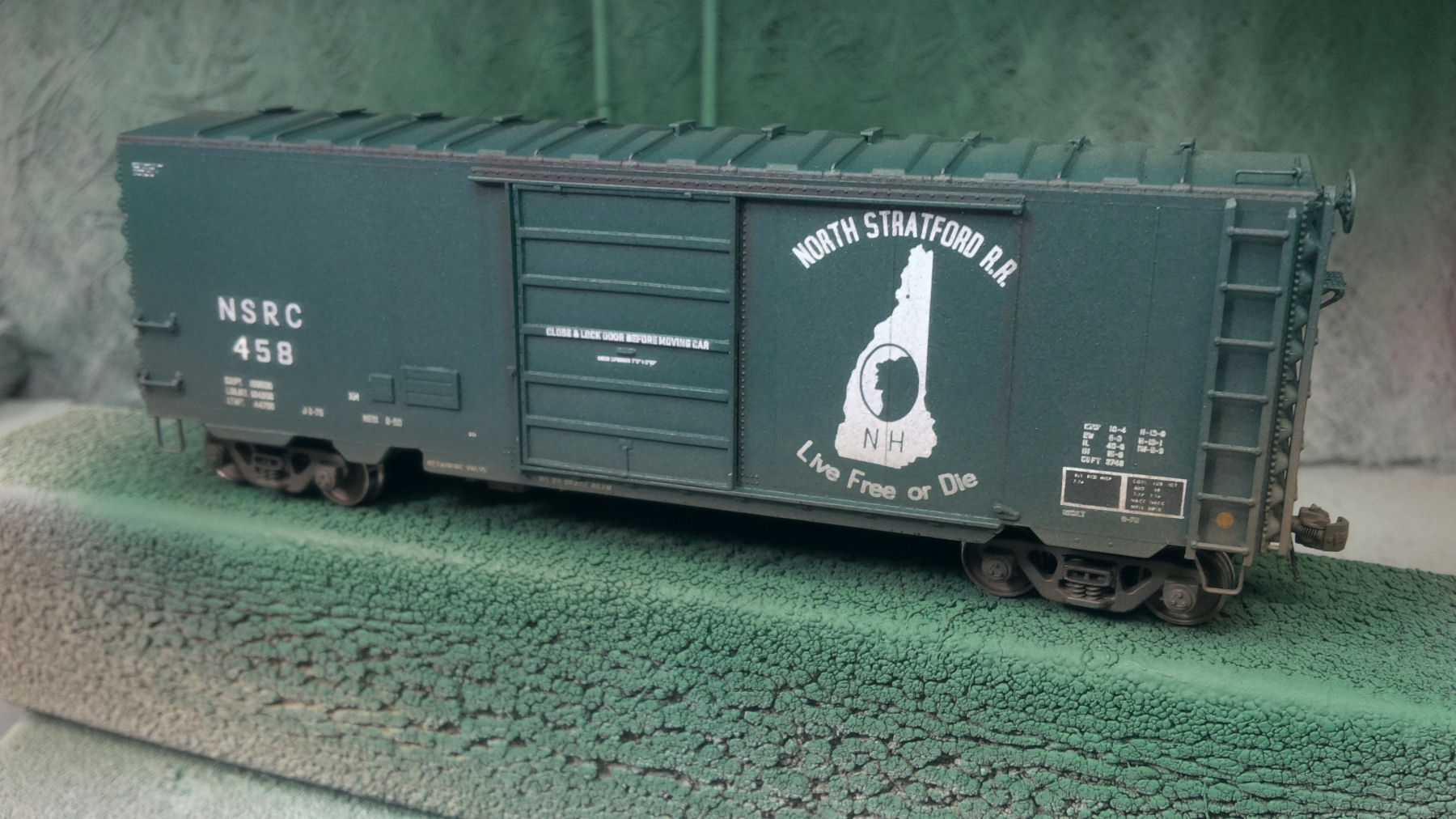
Completed model. Some light weathering was added, mainly road grime around the underbody, and some grunge coming from the roof eaves. A clear flat finish was then sprayed to protect it.

I probably over-weathered this model considering it should still be shiny after it’s rebuilding in 1979, but it just didn’t look right mixed with all the other really grunged-up rolling stock on the club layout. So I airbrushed a light coat of grime along the underbody, and added some dark grungy weathering powder along the roof eaves along with some running down from the door guides. A clear flat coat was then applied to protect the weathering. Combined with the original base gloss finish the model still has a bit of a shine to it, so I’m happy with the over-all result.

In closing, I just wish to reiterate that this kit was up for sale for $5 at the WRMRC table over several Kitchener Train Shows, along with a lot of other surplus ‘fleas.’ For all the complaints on model train forums about the high cost of our hobby, here is proof that if you have the time and are low on cash, you can create quality models while on a budget. You also get the added satisfaction of owning something unique. Personally, I get a kick out of re-creating something I’ve seen in the past, and the research and efforts towards that goal are what make the hobby rewarding. I hope this story inspires others to dig around in future train shows, and look beyond the latest ready-to-run models.

2021 Virtual Tour Video

We are pleased to present another new video for your enjoyment, this time featuring a tour over the current operating portions of the CP Sudbury Division layout.

This video was originally created as our club’s submission for the 2021 Doubleheaders Virtual Layout Tour. Though the event was a great success, the nature of Zoom Meetings prevented the greater masses from being able to view our presentation. There was also the inconvenience of it only running once, and at a fixed time slot.

So we’ve decided to add our video presentation to the club’s YouTube channel for everyone’s entertainment, for anyone to view, pause and repeat at will.

All of us at the WRMRC are looking forward to the near future, where we can meet together again at real club open houses. We’re keeping our fingers crossed for October 16th. In the meantime, we hope this video will suffice.


Virtual Doubleheaders Tour 2021

COVID-19 scuttled the 2020 Doubleheaders Layout Tour, but not this year!

This Saturday March 27, 2021, the Doubleheaders will be hosting a free, online Kitchener-Waterloo-Cambridge-Guelph model railway tour, featuring a number of great home and club layouts from the area.

The WRMRC CP Sudbury Division Modellers will be participating, with a 25 minute presentation touring the operating portions of our layout, and a live question-and-answer session afterwards.

The virtual tour is being held over the Zoom platform, and interested parties must register in advance for information, schedules and Zoom meeting links.

To register, please contact the Doubleheaders via their website.

 cp8829east

Switching ‘The Canadian’ Video Posted

Our club has been rather neglectful in video creation lately, due in no small part to COVID restrictions keeping us from hosting operating sessions and filming the events. However we’ve cleaned the cobwebs and dusted out our YouTube channel, and are pleased to announce a new video.

This explains how a typical 12-car consist of CP train #2 ‘The Canadian’ was switched out at Sudbury into Toronto (CP train #12) and Montreal (continuing as CP #2) sections, and goes through the shunting step-by-step.

Our club goes through this process each operating session, and the reverse process as well (combining Montreal and Toronto sections into one) at the close of the session. It takes up one scale hour (15 minutes real time) to complete, requires four operators to perform all the moves, and completely shuts down the yard while in progress. Needless to say, it’s a pain in the backside for whoever is performing the Sudbury Yardmaster’s roll that op session, but it’s also an operational highlight of the layout.

As the vaccine roll-out continues, we are hopeful that full club operating sessions can be held again later this year, and you may be able to witness switching ‘The Canadian’ in person again.


How Do We Do It? Volume.

There is a current trend among prototype railway modellers to build smaller more sustainable layouts. It was once an ideal to construct very large pikes geared towards operations, where you and a good number of fellow hobbyists would operate together. The problem was that layouts of such size rarely ever are completed within one’s lifetime. So modellers have been pursuing smaller layouts designed to be more faithful to the prototype, operated by a small number of friends, and which can be ‘finished’ within a realistic time-frame. This is a positive movement in the hobby, and a roll-call of some of the layouts featured within the Prototype Modelling Layout Links and Blogs section in the ‘Links’ page of this website shows this to be true.

But on the other end of the sustainable layout spectrum, you’ll find the WRMRC CP Sudbury Division layout. After over 20 years of our membership constructing an entire division of the Canadian Pacific Railway, we can report that this is not something any individual modeller should attempt. There is a lot of time, effort, research, and of course money, that is required to build a layout of this scope.

Volume 5 Rapido FAs

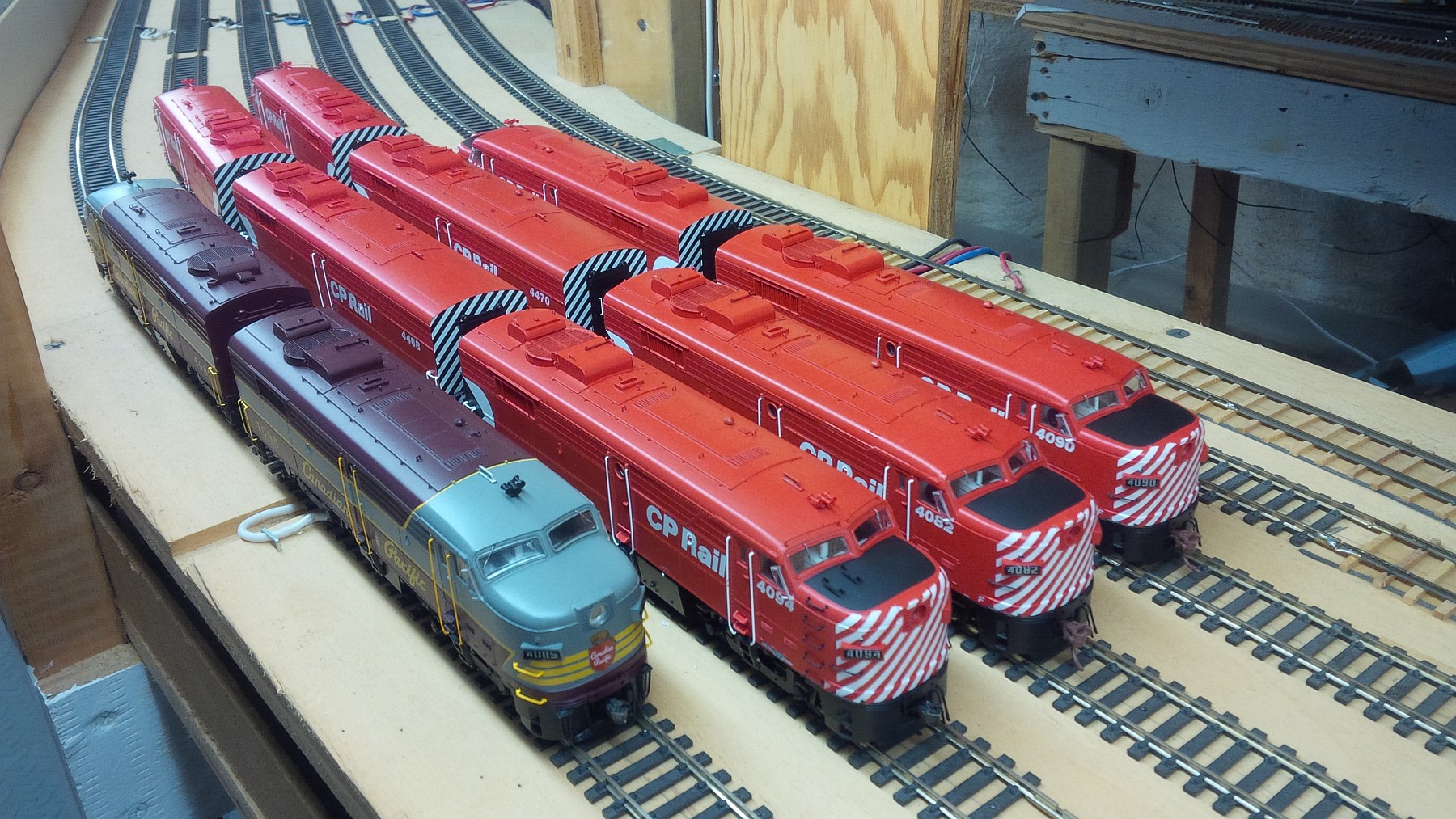
Fresh from some basic decoder programming, a bulk purchase of Rapido CP FA-2, FPA-2 and FB-2 locomotives are gathered together for their official company photographs on the WRMRC layout.

This topic came up at a recent Wednesday work night, when a bit of a WRMRC tradition was being observed. Our latest locomotives from a bulk purchase were belatedly gathered together for their group ‘official company photographs’. In this case it was a dozen Rapido MLW FA-2, FPA-2 and FB-2 locomotives, some of which had to be searched for as they were already in service. With the anticipation of club operating sessions being held again in the future, it was best to gather them all together for their official portraits now before the CP Motive Power Bureau scatters them to the four corners of the layout.

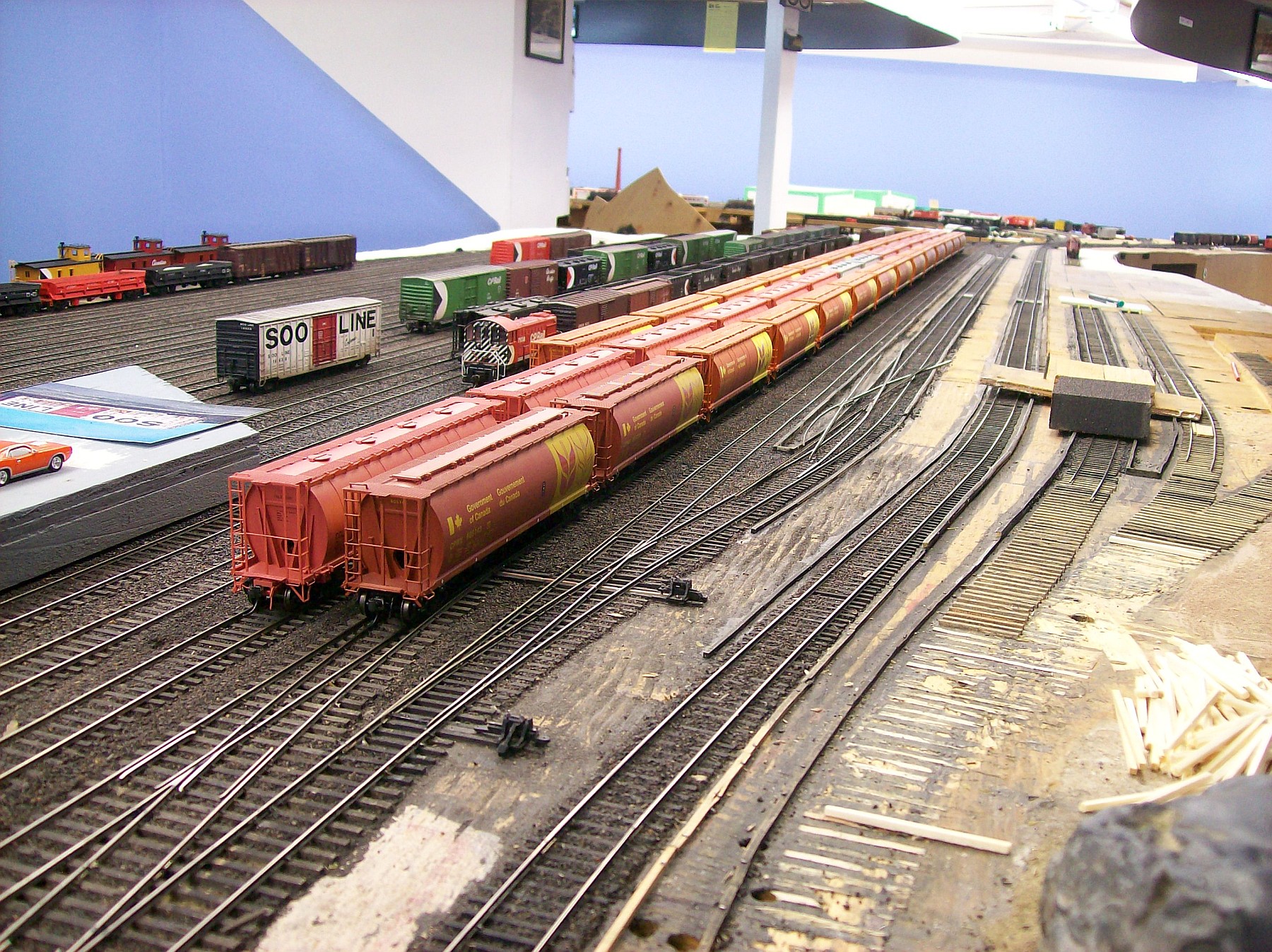
Volume 1 Hoppers

Three dozen 4550 CuFt Hawker-Siddeley cylindrical hoppers decorated for Canada Wheat Board (CPWX) and Saskatchewan Potash received from the  North American Car Corporation.

This brought up a discussion later among the membership present about layout size, sustainability and how fortunate we are in the WRMRC where we all get along so well. The obvious advantage of any train club is to be able to finance and construct a layout larger than any individual could. Unless you are independently wealthy, who can afford to buy 10 DCC sound-equipped locomotives in one shot? But there is much more than pooling our time and resources. From its founding the WRMRC set clear goals for modelling the CP Sudbury Division, and from this came not just a combination of talent and resources, but also friendships and an overall camaraderie have developed.

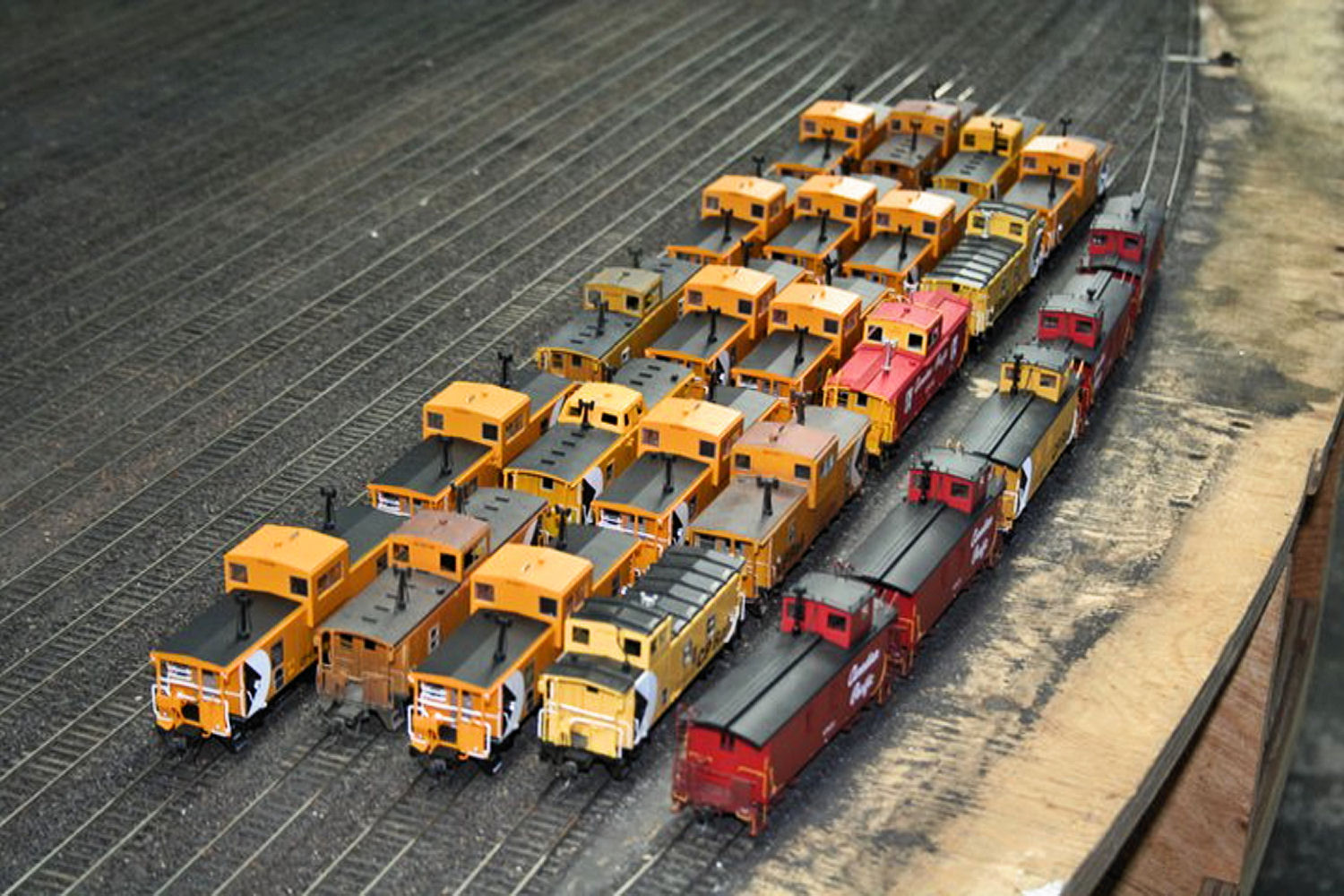
CP vans on WRMRC

After a delivery of 12 Rapido CP Angus wide-vision vans was received, a group photo of our entire cabooses fleet was taken. These include CP wood-sheathed vans from True Line Trains, some Overland brass cabooses, and a few craftsman resin models built from Sylvan kits.

Volume 2 Canadian

Two full sets of ‘The Canadian’ trainsets from Rapido Trains. This delivery made the longstanding WRMRC dream of operating the CPR’s transcontinental passenger flagships come true.

That said, when we do pool our resources together it really is something. One of our members suggested we show some of these bulk equipment pictures. This makes for a bit of a ‘shock and awe’ photo collection, but these are some of the pics taken over the years.

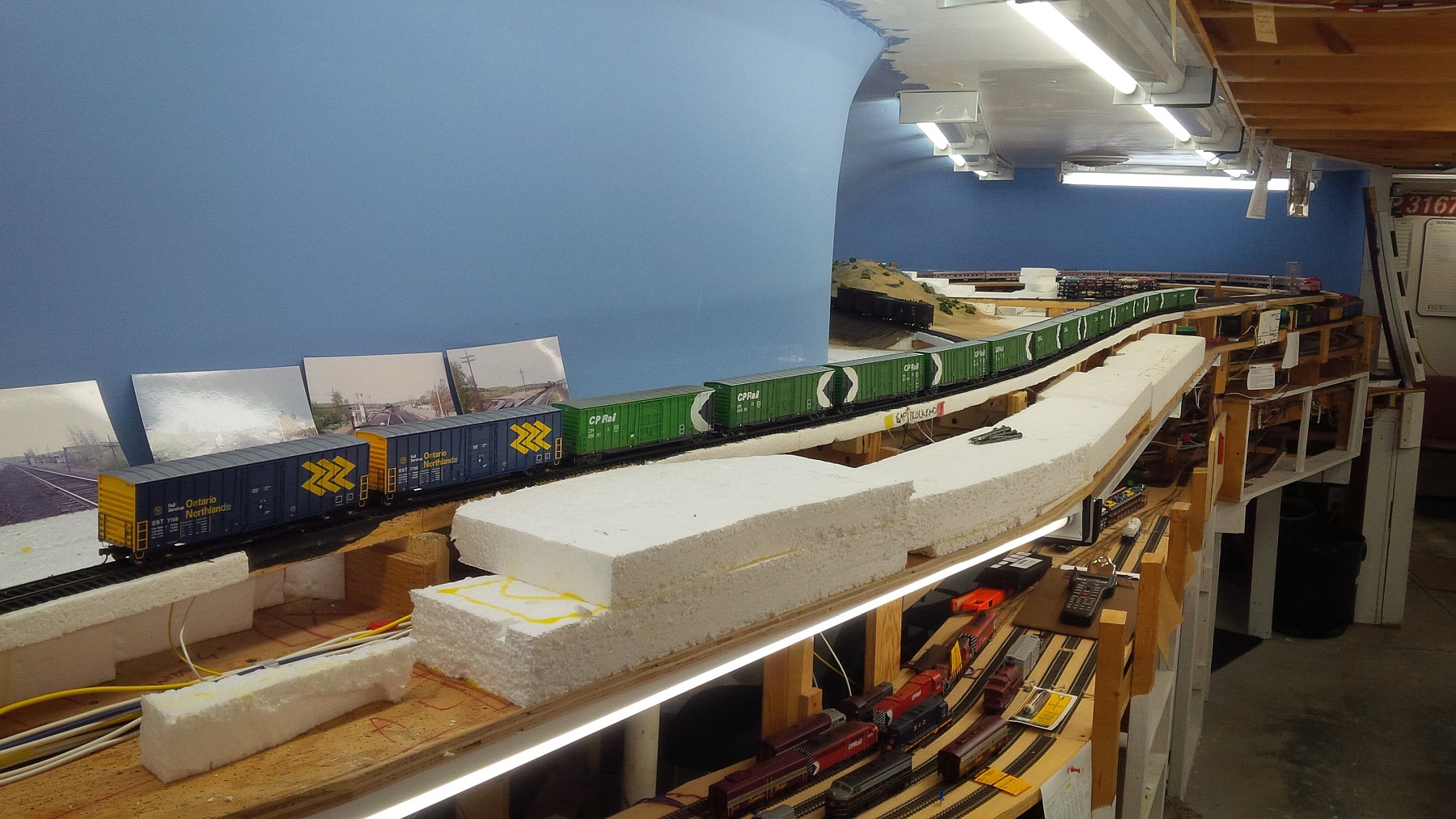
Volume 3 Paper Cars

Two Ontario Northland cars are dwarfed by 15 CP Rail models in a bulk purchase of NSC PD Boxcars from the Atlas Model Railroad Company.

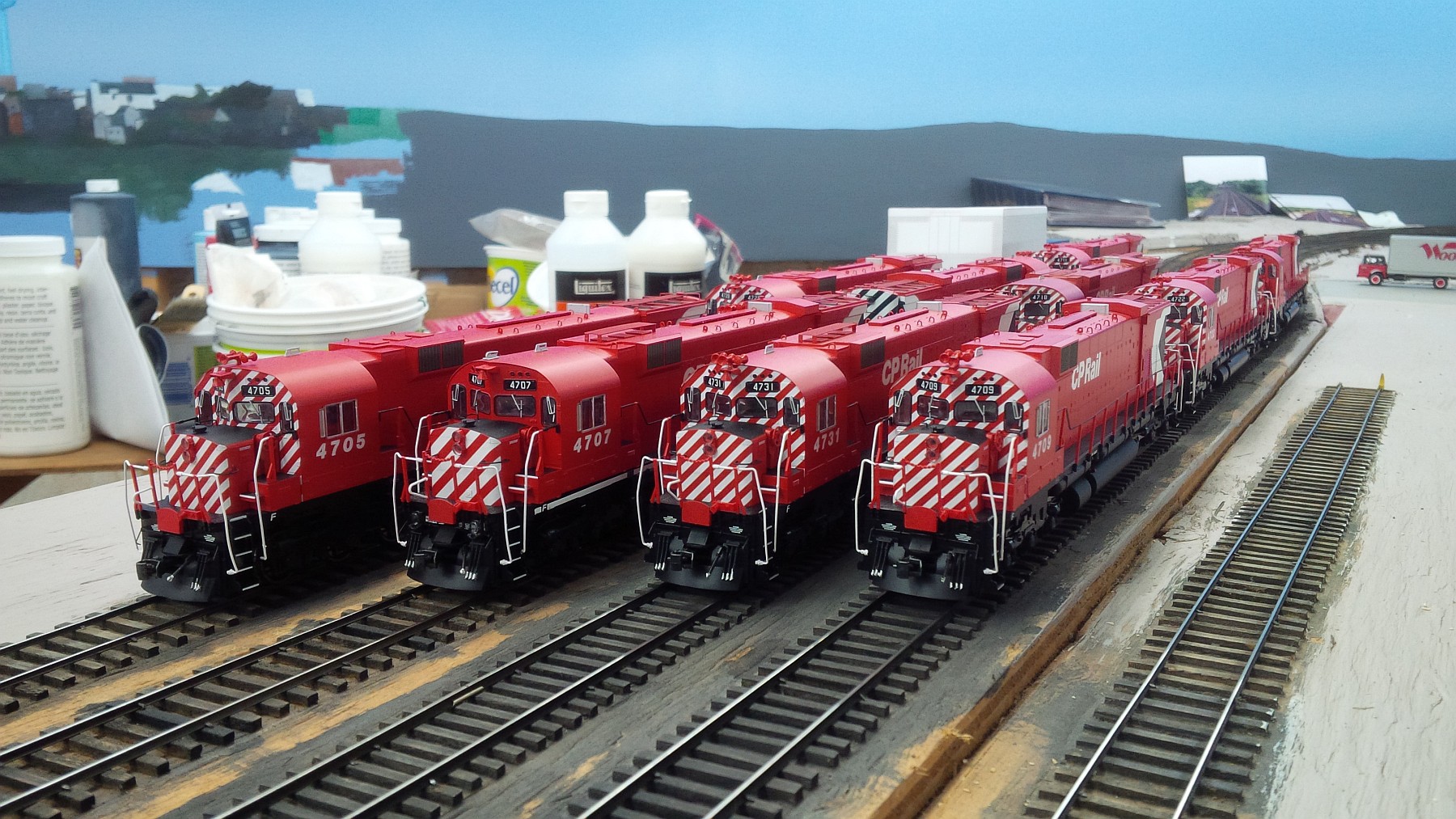
Volume 4 Big Alcos

A delivery of ten MLW model M-636 locomotives from Bowser Trains.

That old advertising line ‘How Do We Do It?’ may be passé, but in regards to large club layouts, it is true.